Games
Hearts of Iron IV 1.19.3
GamesUpdated
| Requirement | On file |
|---|---|
| macOS | See the sheet |
| CPU | Intel 64-bit |
| Download | 6 GB |
| Tested on | macOS Tahoe, Mac mini 2024 M4 |
Assigning industrial capacity to a new line of medium tanks is a decision that will not pay off for six in-game months. That kind of delayed-reward thinking defines the core loop. Hearts of Iron IV is a grand strategy title from Paradox Development Studio that asks you to direct a nation during World War II. You can fight, negotiate, or organise invasions—often all three simultaneously.
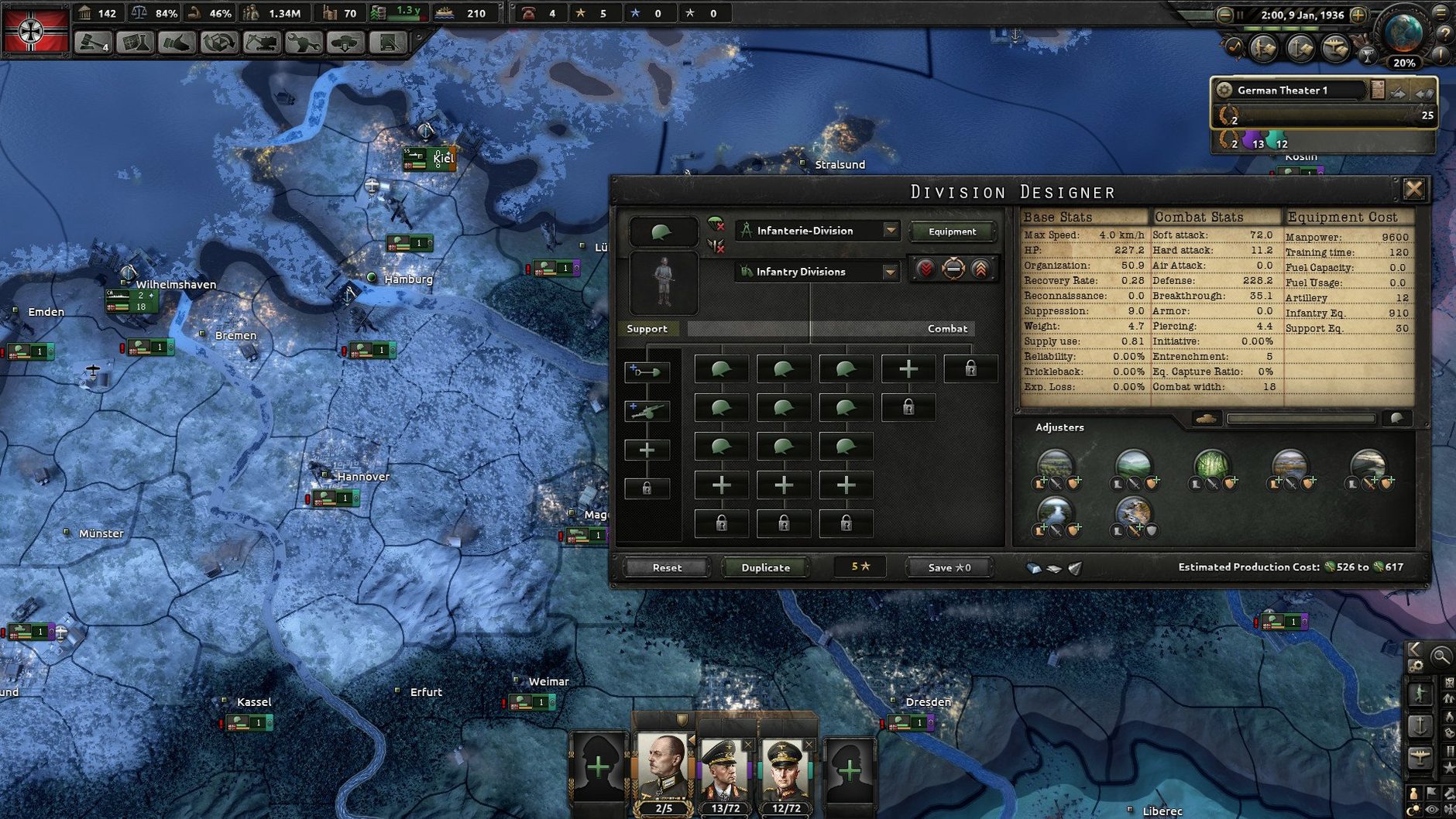
This game suits players who enjoy managing production queues, supply lines, and division templates over several sessions. If watching a front line shift after three hours of logistical preparation sounds satisfying, the mechanical depth here will click. The interface rewards learning, but it does not cushion the first few hours.
It will likely frustrate anyone wanting a fast-paced tactical experience. There are no quick reaction tests or set-piece battles; the outcome of a campaign rests on decisions made in the supply tab. The voice language is music only, so all feedback is visual, which adds to the spreadsheet-like atmosphere. This is a machine for testing alternate-history scenarios, and it works best when you treat it like one.
Alternate-History Sandboxes and 200-Hour Rabbit Holes
Not every strategy player will sink 200 hours into a single title. The people who do tend to fall into a few distinct clusters.
Alternate-history tinkerers treat the game as a sandbox for counterfactuals. They are the ones asking what happens if Mexico joins the Axis in 1939, or if Sweden holds a united Scandinavia against both the Soviets and the Reich. The 1.19.3 patch feeds this group directly—the new secret path for Australia and the late-game content for Siam and Indonesia are built for players who have already exhausted the major powers and want smaller nations with unexpected options.
Systems-layer strategists gravitate toward the production and logistics tabs. These players get a quiet satisfaction from setting up a convoy escort pattern that keeps rubber flowing from Malaya to Berlin through three sea zones. They will pause on 1 January 1940 and spend twenty minutes reworking division templates before unpausing. The game rewards this patience with outcomes that feel earned because the causal chain is visible—a shortage of tungsten really does translate into fewer medium tank battalions six months later.
Multiplayer diplomats form a third group. In a session with six or eight human players, the diplomatic layer stops being a checkbox and becomes the central mechanic. Alliances shift, non-aggression pacts get broken at inconvenient moments, and the chat window hums with half-truths. These players value the fact that Hearts of Iron IV gives them tools to lie persuasively, not just buttons to press.
Military-history readers complete the picture. They recognise the division designations, understand why encirclement matters more than raw casualty counts, and care about getting the historical order of battle roughly right. For them, the game is a way to interrogate the constraints that shaped real decisions—industry, terrain, weather, and time.
What connects all four groups is comfort with delayed gratification. If a player cannot enjoy a session where the payoff arrives three hours after the setup, Hearts of Iron IV will feel like work. For everyone else, it becomes a second home.
Nation-Agnostic Traps That Force Early Restarts
New players tend to trip over the same few things, regardless of which nation they pick first. Recognising these early saves restarts.
Ignoring Supply Until Divisions Starve
The supply map mode exists for a reason. Pushing thirty divisions into low-infrastructure terrain—the Sahara, the Burmese jungle, the Soviet interior—will collapse their organisation faster than any enemy attack. A beginner sees a wide front and fills it. An experienced player checks the supply region first, counts the available capacity, and only commits what the rails and ports can support.
Treating Battle Plans as Autopilot
Drawing an offensive line and pressing execute does not mean the AI will fight well. It means divisions will shuffle into position and begin probing attacks along the whole front. The resulting casualties come from attacking into unfavourable terrain with no concentration of force. Manual control of breakthrough divisions—two or three tank corps aimed at a narrow sector—produces encirclements. The battle plan can hold the line elsewhere, but the spearhead needs a human hand.
Neglecting Air Superiority
A common new-player stack: a hundred infantry divisions and six fighter wings total. Ground attack numbers look fine on paper. In practice, enemy close-air-support planes will shred advancing units while friendly divisions fight with a penalty. The air war is not optional; it is a prerequisite for offensives. Build fighters early, upgrade them, and assign them to the right zones before the first shot is fired.
Overproducing Equipment Without a Manpower Plan
Factories churn out rifles and artillery, stockpiles climb into the tens of thousands, and everything looks healthy. Then the manpower counter hits zero. Divisions stop reinforcing, and the front collapses. New players often confuse equipment stockpiles with combat readiness. The conscription laws exist precisely because men are a separate resource, and bumping the law up takes political power that may not be available when the crisis arrives.
Language Toggle Quirks and Deep-Simulation Friction
Even experienced hands run into friction points. Some are design quirks; others are consequences of the simulation's depth.
Snag: The launcher refuses to switch languages, or the game starts in Russian despite changing the setting. Fix: The language toggle lives inside the dowser launcher, not the game itself. Navigate into the application bundle—right-click the game, choose Show Package Contents, then go to Contents > Game and run the dowser file. Set the language there, close the launcher, and reopen it. The game inherits whatever the launcher is set to.
Snag: Late-game slowdown, especially around 1943–44, turns the clock to a crawl. Fix: The engine simulates every division on the map, and by the late war the major powers field hundreds. Reducing the number of expeditionary forces sent to allies helps—fewer units moving means fewer calculations. Turning off day/night cycle animation and lowering the graphics preset can also claw back some speed, though the bottleneck is usually the CPU, not the GPU.
Snag: Naval invasions fail without explanation. The plan is drawn, the divisions are assigned, and nothing happens. Fix: Check three things. First, naval superiority in every sea zone the invasion route crosses—not just the destination. Second, sufficient convoys in the stockpile; invasions eat them up. Third, the invasion capacity limit, which is tied to the transport technology researched. Trying to send ten divisions with a capacity of four leaves six standing on the dock.
Snag: A faction member drags you into an unwanted war. Fix: This is a political calculation error, not a bug. Before joining a faction, check the diplomatic status of every other member. If one of them has a tension spike with a major power, joining means inheriting that tension. The fix for an ongoing situation is to leave the faction—painful, but sometimes necessary. In single-player, an earlier save offers a cleaner solution.
Workflow: Turning Australia Fascist and Seizing the Pacific
The 1.19.3 secret path for Australia provides a concrete example of how a campaign moves from concept to execution. This workflow assumes a start in 1936 with historical focuses off, which unlocks the alternative political branches.
Phase 1: Political groundwork (1936–1938). The first focus picks go into the fascist branch. Political power accumulates slowly, so the initial spend goes to a fascist demagogue advisor—this shifts ideology support by roughly 0.10 per day. Ignore the temptation to queue industrial focuses early; the political pivot must happen before the world locks into factions. As fascist support passes 40%, the government can be reformed. The civil war option is available but avoidable with patience. By mid-1938, Australia sits under a fascist government with enough stability to begin rearmament.
Phase 2: Industrial focus and a naval yard programme (1938–1940). With the political tree moving, attention shifts to dockyards. Australia starts with a negligible fleet, and a Pacific strategy requires convoy raiders and naval bombers. Ten dockyards on destroyers, five on submarines. The civilian factory count is small—building more civilian factories early means fewer military factories later, so the ratio stays tight. By early 1940, two full production lines run on infantry equipment, one on artillery, one on support gear.
Phase 3: The Indonesian campaign (1940–1941). The late-game content for Indonesia introduced in 1.19.3 matters here because it changes the regional balance. The Dutch East Indies are not simply a passive resource pool; they have their own focus tree branches that can trigger resistance or collaboration. The Australian invasion plan targets Java first—seize the rubber and oil, then use those resources to fuel a larger navy. Naval invasions require planning time, so the order goes in two months before the declaration. The Royal Navy is not coming to help; the fleet must handle its own escort duty.
Phase 4: Consolidation and the Siam pivot (1942 onward). Once Java is secure, the supply base supports a push north. The new Siam content means the Thai peninsula is no longer a speedbump—it can field a respectable defence if left alone too long. A combined naval invasion of the Kra Isthmus and a land push from Malaya squeezes Siam between two fronts. The reward is control over the rubber-heavy Southeast Asian trade zone and a staging ground for whatever comes next, whether that is a strike at India or a long naval campaign across the Pacific.
The whole sequence takes roughly six to eight hours of play. It works because each phase feeds the next: politics unlocks industry, industry builds the fleet, the fleet enables the invasions, the invasions provide the resources for the late game. Missing any link in that chain—rushing the invasion before the dockyards are ready, say—turns a clean campaign into a slog.
Secret path — added for Australia.
Late-game content — added for Siam and Indonesia.
Gameplay — balance changes and bug fixes applied.
- Architecture: Intel
Questions on file
Can I change the outcome of World War II in Hearts of Iron IV?
Yes. The game is designed around alternate-history possibilities, allowing you to try and change the war's outcome through strategic choices.
What kind of player is Hearts of Iron IV suited for?
It is suited to patient players who enjoy deep logistical planning, production management, and long-term strategic thinking over immediate tactical action.
Does Hearts of Iron IV include spoken voice lines?
No. The listed voice language is music only, so all feedback during play is delivered through the interface.
Sign in · Create an account to add a field note.
No field notes yet. A measurement, a version, a machine — they appear after moderation.