
Games
Stellaris 4.5.1
GamesUpdated
| Requirement | On file |
|---|---|
| macOS | See the sheet |
| CPU | Intel 64-bit |
| Download | 21 GB |
| Tested on | macOS Tahoe, Mac mini 2024 M4 |
Stellaris runs on any Intel-based Mac with a 64-bit processor. The interface ships in eight languages: Russian, English, German, Spanish, Simplified Chinese, Polish, Portuguese, and French.
Minute-to-Minute Gameplay
The clock never stops. As your empire expands, the core loop settles into a rhythm of resource triage, diplomatic micro-management, and scientific queue management. Here is what fills a typical session:
- Research queue management. You constantly shuffle anomalies and special projects to unlock distant star lanes.
- Economic triage. Overgrown settlements generate internal conflicts. You shift budget allocations between consumer goods and alloys while using artificial intelligence governors to pacify autonomous regions.
- Diplomatic posture. Envoys are assigned to improve or harm relations in real time. Federation law votes and first-contact protocols trigger pop-ups that pause the map.
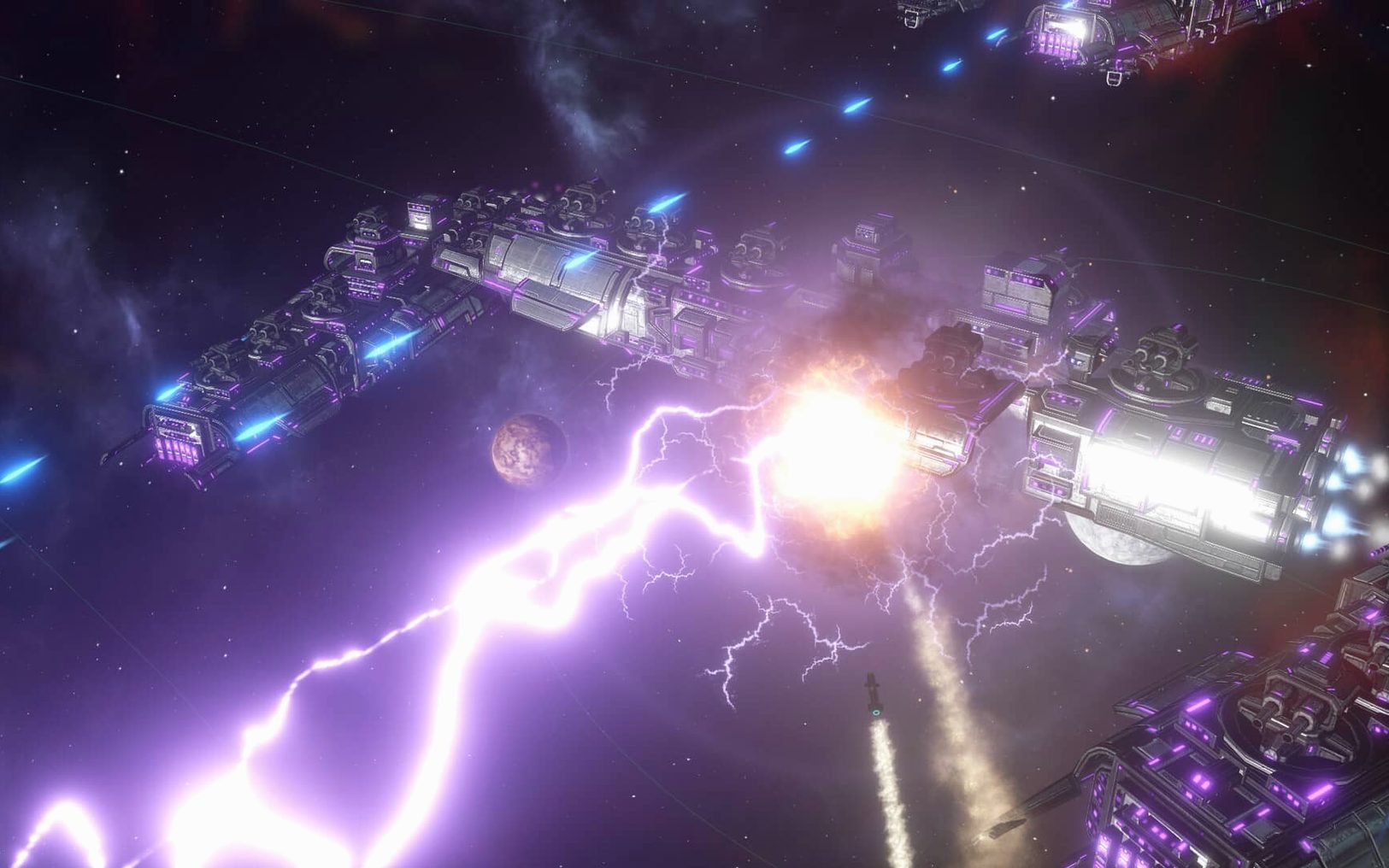
- Fleet babysitting. Version 4.5.1 disables auto-disengagement after 15 days of battle inactivity, so a fleet left on aggressive stance will fight until its hull is gone. You set and re-set fleet automation behaviour manually during engagements.
Internal Pressure and the Mid-Game Pivot
Once a handful of planets reach double-digit population counts, growth becomes a liability. Settlements generate faction demands that drain influence if ignored. The shift from exploration to internal stability is where the Paradox Development Studio design heritage from Crusader Kings and Europa Universalis shows most clearly. You are no longer just an explorer; you are a logistics manager balancing resource deficits against a ticking diplomatic clock.
Turn-Based Neighbours vs. Stellaris’s Real-Time Clock
Three other 4X and grand strategy games run natively on Intel Macs and occupy roughly the same headspace, but they pull in different directions.
Endless Space 2 shares the turn-based layer that Stellaris lacks. Where Stellaris ticks forward in real time with a pause button, Endless Space 2 breaks the game into discrete turns for fleet movement and colony management. That makes it easier to digest for players who want to study every decision, but it also removes the pressure of a clock that never stops. The faction design in Endless Space 2 is more rigid: each empire follows a narrative questline, whereas Stellaris generates its factions organically from material conditions inside your empire. If you prefer authored stories with clear endpoints, Endless Space 2 delivers them. If you want systems that collide and produce outcomes nobody scripted, Stellaris fits better.
Sins of a Solar Empire: Rebellion strips empire management down to a more aggressive combat loop. There is no equivalent to Stellaris's faction system, no internal politics, and research trees are leaner. What you gain is fleet battles that feel more tactile, with capital ships that level up and abilities you trigger manually. Sins runs faster on older Intel hardware, so it is worth a look if your Mac struggles with late-game Stellaris galaxy sizes. The trade-off is depth outside warfare: diplomacy in Sins is binary, and population management barely exists.
Distant Worlds: Universe is the closest cousin in ambition but the furthest in interface design. It simulates a living galaxy with civilian freighters, private-sector mining, and automated fleet patrols. Stellaris gives you tighter control via the governor system and the budget screen. Distant Worlds leans hard into letting the simulation run itself while you watch; Stellaris expects you to make calls every few minutes. The Distant Worlds interface feels cluttered on a MacBook display, where Stellaris benefits from Paradox's years of UI iteration.
Three Gameplay Toggles That Stop You Fighting the Interface
The default configuration works, but three adjustments make the difference between fighting the interface and fighting the xeno threat.
- Auto-pause on events. Open the game menu, go to Settings → Gameplay, and enable auto-pause for pop-up events, first contact, and war declarations. The real-time clock does not wait for you to read a federation law vote. Without these pauses, you will lose fleets while parsing a dialogue box.
- Fleet stance defaults. Version 4.5.1 changed fleet automation so it follows your selected actions more literally. Head into Ship Designer after your first few tech unlocks and set the default stance for new ship classes. Aggressive fleets no longer auto-disengage after 15 idle days, so a patrol group left on aggressive will fight to destruction. Set patrol corvettes to Passive unless you intend to reinforce them constantly.
- Galaxy size and habitable worlds multiplier. The galaxy generation screen defaults to a 600-star elliptical. Drop habitable worlds to 0.75× and turn off guaranteed colonisable worlds within two jumps. The scarcity forces earlier diplomatic engagement and makes each habitable planet discovery feel significant. On a Mac with an Intel processor, this also keeps late-game performance within reasonable limits by reducing pop-count bloat.
Year 2235: Three Planets, One Hostile Neighbour
A session starting at year 2235, mid-early game, with three colonised planets and one hostile neighbour on the coreward border.
You load the save. The clock resumes immediately. Your science ship in the Trappist system has finished surveying an anomaly — a derelict station with a level-three anomaly difficulty. You queue a special project to investigate it, which pulls your head physicist off shield research for 180 days. The opportunity cost is real; you accept it because derelict stations sometimes reveal precursor data that shortens the archaeology chain.
Your consumer goods deficit flashes orange. One click opens the Planets and Sectors screen. Your homeworld has 14 pops and a newly spawned egalitarian faction demanding demilitarisation. Ignoring them costs two influence per month. You check the budget screen: alloys are at +22, influence at +3. You assign an envoy to suppress the faction and shift one industrial district to civilian industries, dropping alloys to +14. The influence tick stabilises.
A first-contact pop-up fires. Auto-pause engages. An unknown empire has entered the neighbouring system. You set your envoy to peaceful first contact and order the construction of a starbase in the border chokepoint system. The construction ship is two jumps away; you queue the move order and unpause.
The hostile neighbour on the coreward border closes their borders. Your construction ship path re-routes automatically. You open the diplomacy screen, send a delegation to improve relations, and check their relative fleet power: Superior. You set your shipyard to build two more destroyers and re-queue the starbase construction to a fallback system one jump inward.
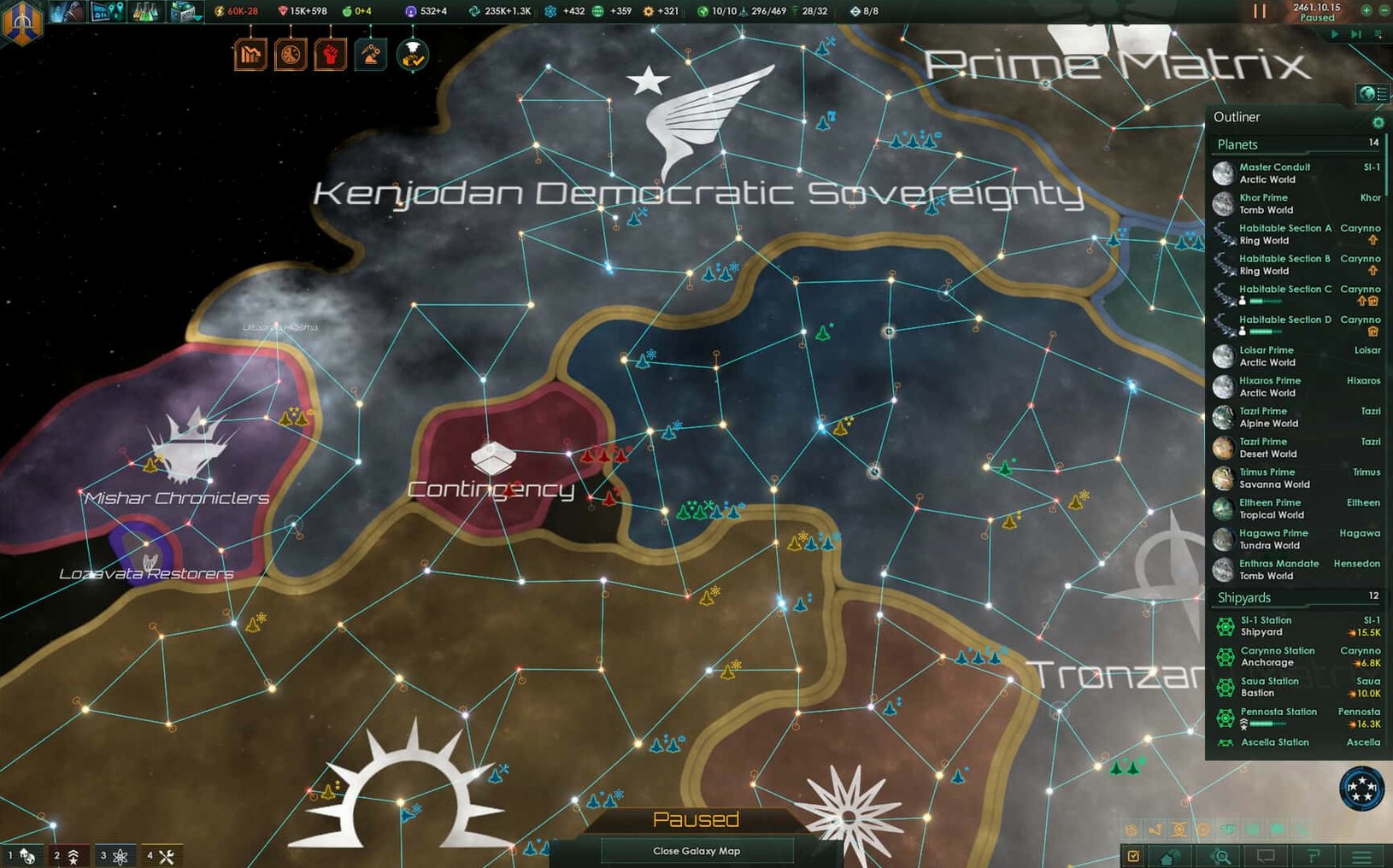
Clock hits 2237. The derelict station project completes and reveals a precursor homeworld marker. You rename the system, pin it to the outliner, and set a construction ship to build an outpost there. That is a 20-minute decision chain resolved. You save and let the clock run while you check the situation log for overdue anomalies.
A Xenobiologist's First Ten Hours
Imagine a player who approaches Stellaris not as a conqueror but as a cataloguer. Their goal is to document every alien species and pre-FTL civilisation in a medium spiral galaxy. They pick the Xenophile and Materialist ethics with the Environmentalist civic, giving their empire bonuses to observation posts and reduced blocker clear time.
The early game is spent racing science ships to unsurveyed systems before rival empires claim them. Every habitable world with a primitive civilisation gets an observation post rather than a colony. The player builds society research stations aggressively, because anomaly discovery chance scales with scientist level and society tech unlocks the Xenology tree. By year 2270, they have catalogued fourteen alien species, uplifted two pre-sentient races, and established observation posts over a bronze-age civilisation and an early space-age industrial world.
The mid-game pivot hits when a xenophobic fallen empire awakens two jumps from the observation post cluster. The player has invested so heavily in science that their fleet is a token patrol group of fifteen corvettes. They scramble to retrofit observation posts with cloaking fields, pull envoys into a defensive pact negotiation with a neighbouring federation, and rush the Xeno Diplomacy tradition tree for the trust-growth bonus. The cataloguer's game has become a game of hiding irreplaceable observation data behind diplomatic screens while the galaxy tilts toward war. The species log, now 22 entries long, is the only scoreboard that matters.
- Hotfix — resolves a Synaptic Lathe ownership issue.
- Fleet automation — behaviour during combat and patrols improved.
- Multiplayer — out-of-sync bugs and multiple crash cases fixed.
- macOS: not specified; requires 64-bit processor
- Architecture: Intel
Questions on file
What changed in version 4.5.1?
It is a hotfix release that resolves crash cases during startup, galaxy generation, alliance formation, wars, first contact, federation law votes, and subject release events.
Can the AI manage parts of my empire?
Yes, artificial intelligence governors can manage autonomous regions, which becomes useful as internal conflicts grow with larger populations.
Is combat turn-based or real-time?
Everything takes place in real time, though pop-up events and pause function allow you to issue orders without time pressure.
Sign in · Create an account to add a field note.
No field notes yet. A measurement, a version, a machine — they appear after moderation.