
Games
Plutocracy 0.260916
GamesUpdated


| Requirement | On file |
|---|---|
| macOS | See the sheet |
| CPU | Apple Silicon, Intel 64-bit |
| Download | 6.4 GB |
| Tested on | macOS Sequoia, MacBook Air (M1. 2020) |
Plutocracy is a 2D business strategy game about rising from a nobody to a shadow ruler during the era of early U.S. big business.
- Starting position — the player begins with nothing and builds an economic empire from scratch.
- Company management — manual control is available alongside automated management via hired directors.
- Financial instruments — issuing stocks and bonds is a core tool for raising capital and expanding operations.
- Market competition — company takeovers, hostile buyouts and the formation of trusts, monopolies and cartels define the competitive layer.
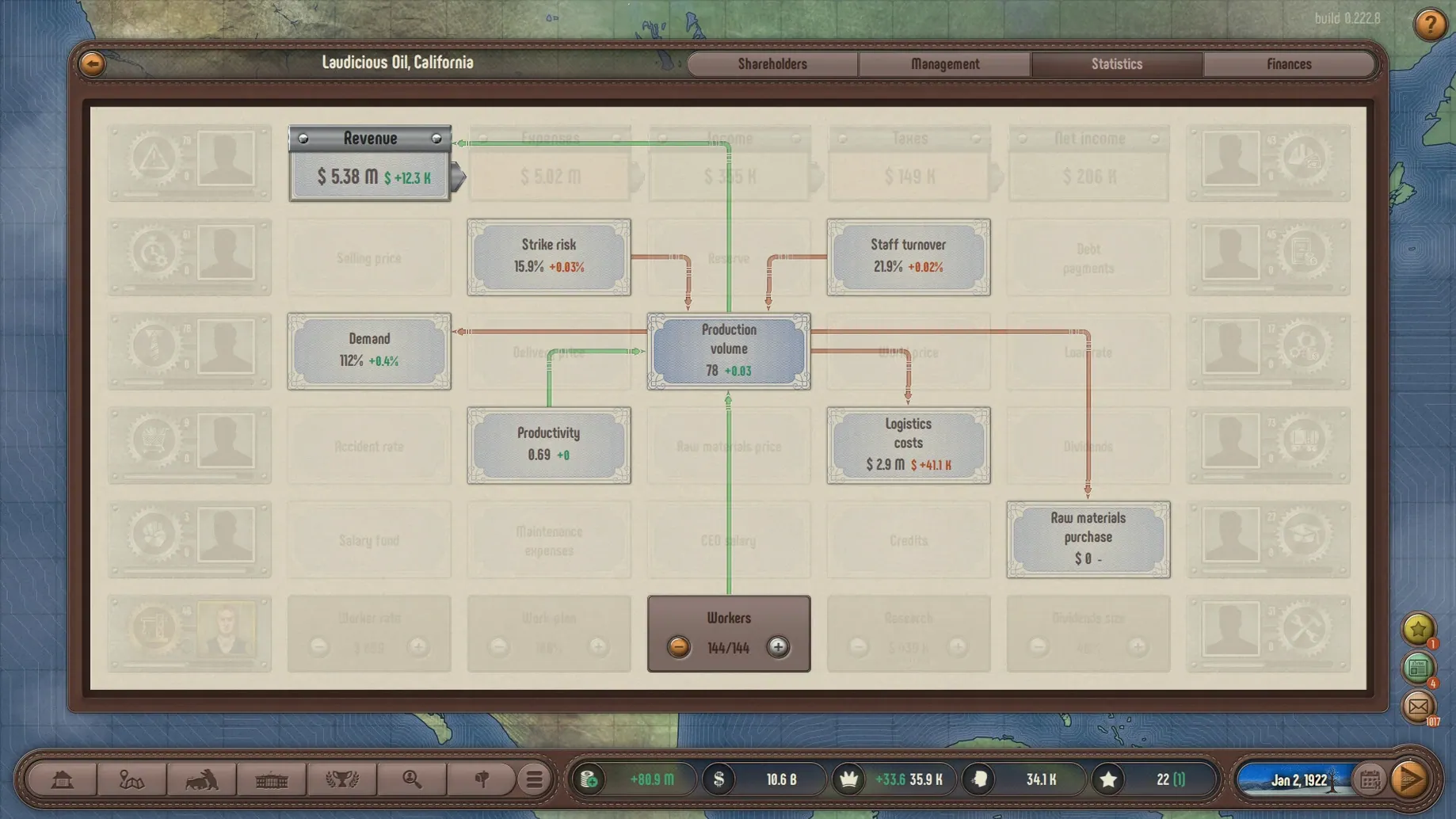
- Labour dynamics — strikes can reduce production output and cause financial losses if left unresolved.
- Political influence — lobbying politicians and shaping laws is modelled as a direct mechanic, not background flavour.
- Early Access state — the game entered Steam Early Access on 22 November 2019 and remains in active development at version 0.260916.
Resist the Production Company Urge
Plutocracy drops you into the deep end with little hand-holding. The first session is about resisting the urge to buy a production company immediately. A more reliable start is to open the directory of available enterprises—pressing Tab cycles through the interface panels quickly—and scan for a small retail firm with a net profit above $3,000 and low debt. Retail generates turnover without the wage pressure and raw-material chains that sink early manufacturing plays.
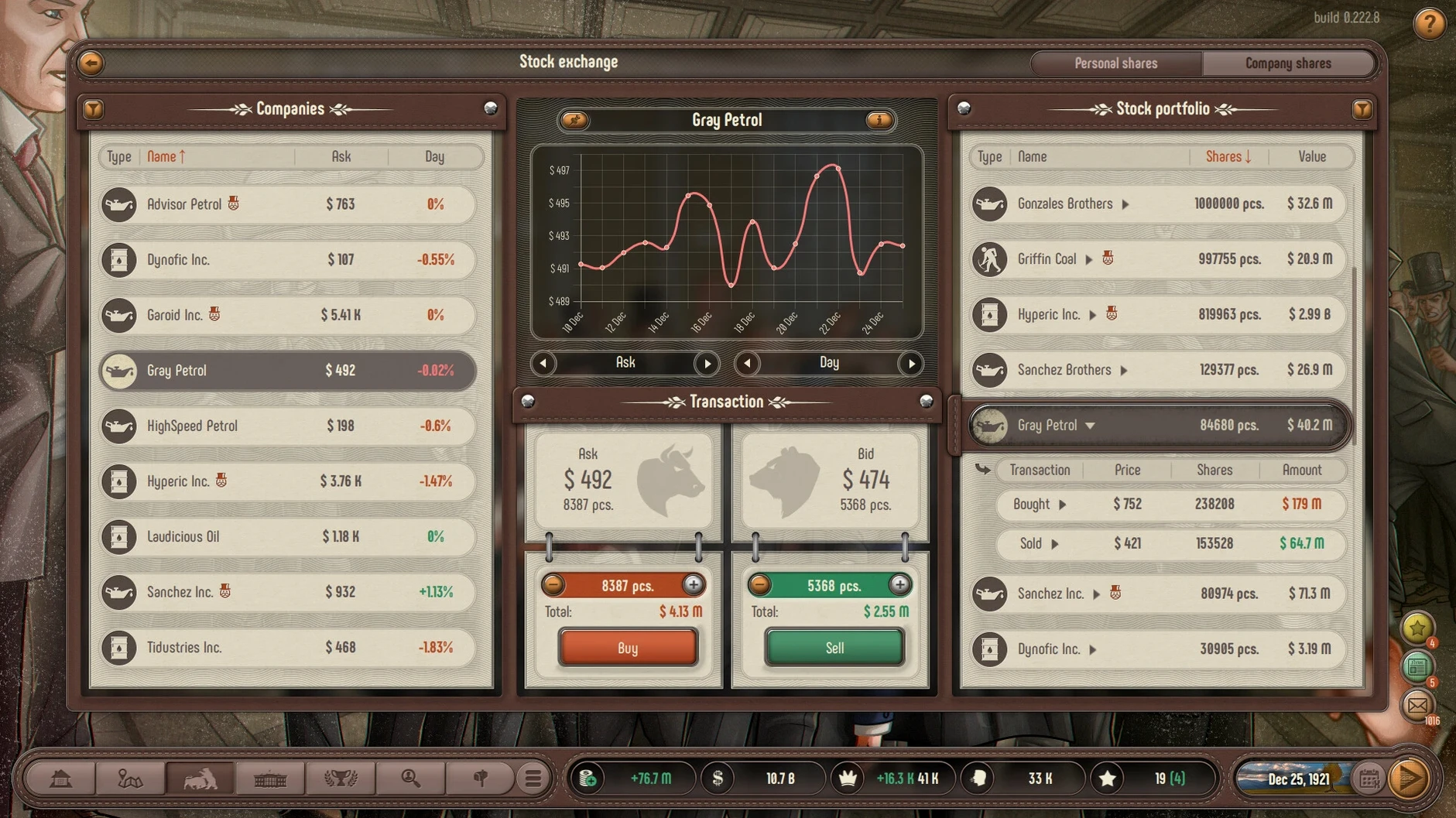
Spend the first hour purely in the stock market screen. Watch which sectors dip on Monday mornings and which rebound by Friday evening game time. The simulation re-rates company valuations daily, and a pattern becomes visible: railway shares often slump mid-week, then correct when quarterly reports land. Buy a 5–10% stake in a mid-cap railway, borrow only against dividend yield, and wait two cycles before touching any other mechanic. This teaches the rhythm of the economic engine without burning cash on legal fees.
Automated directors look tempting but early on they are a trap. A director with a “cautious” trait will sell inventory during a price spike that a player would ride for another quarter. Keep manual control until the company has at least three subsidiaries; then assign a director to the least profitable one and watch their decisions for a full year before trusting them with a flagship asset.
The political map is the last thing to touch in week one. Lobbying costs scale with your public profile, and a newcomer with a modest net worth gets little return. File it under “things to observe,” not act on, until your personal wealth crosses $500,000.
Reading Balance Sheets Like Hostile Takeovers
Players who enjoy reading a balance sheet as much as executing a hostile takeover will find the most here. The game models the interplay between corporate finance and legislative manipulation with a granularity that rewards patience over fast clicking. Three groups stand out.
Spreadsheet-minded strategists. If you have ever built a discounted cash-flow model for fun, Plutocracy’s financial layer will feel like home. The bond-issuance mechanic carries through to real coupon obligations that hit your quarterly income statement, and over-levering into a margin call can unravel a holding company in twenty minutes. Every number on the income statement traces back to a decision you made, not a random event.
History and economics enthusiasts. The Gilded Age setting is not decorative. The 15,000 characters have material interests—a senator from an iron-producing state votes differently on tariff bills than one from a farming region—and the simulation of GDP, unemployment and price indices responds to large-scale actions by the player and AI rivals. Forming a steel trust genuinely shifts the national cost base for rail construction, and you see the effect in every transport company’s margin.
Players who enjoy opaque, systemic worlds. Plutocracy does not tutorialise its corruption mechanics. Bribing a judge carries a percentage chance of an indictment that climbs with the visibility of the case. Sabotaging a competitor’s factory might cut their output by 12% or land you in court for three quarters. The game trusts you to learn the odds through failure, which suits anyone tired of strategy titles that surface every probability in a tooltip.
Dedicated macOS Space for Spreadsheet Allies
Plutocracy runs as a standard windowed application and plays well with macOS Spaces. Keeping the game in a dedicated Space—swiping left with three fingers to reach it—lets you keep a spreadsheet or notes app open in an adjacent Space without alt-tabbing. The game’s economic data is rich enough that some players run a second monitor with a simple ledger in Numbers or a text file in Notes to track sector rotations, since the in-game history only holds the last two quarters of financial statements.
Notification Centre integration is absent, which is worth knowing. A long-running simulation will not ping you when a strike begins or a court verdict lands; you must be present or accept the consequences. For that reason, players who use Focus modes on macOS often create a “Plutocracy session” focus that silences everything except the game audio, treating a session like a deep-work block.
The game writes save files locally to ~/Library/Application Support/ and they are small enough—typically under 8 MB even in late-game—that Time Machine snapshots capture every state change without bloating backups. If you play across multiple Macs, moving the save folder into an iCloud Drive-synced directory with a symlink works, though the developer does not officially support cloud sync and simultaneous access from two machines will corrupt the file.
Accessibility-wise, the UI uses a fixed 2D layout with panel-based navigation. Zoom is not supported, but the high-contrast colour scheme for financial tables (green for profit, red for loss, black for neutral) holds up under macOS’s Increase Contrast display setting. VoiceOver does not read the in-game ticker or the stock-market depth chart, so players relying on screen readers will hit a wall in the trading screens.
The community around the game tends to share sector-analysis spreadsheets in CSV format, and Numbers on macOS imports these without mangling the decimal separators—something that occasionally trips up Excel users on other platforms. If you are the sort of player who reverse-engineers a Plutocracy crack Mac strategy by plotting price elasticity data from five game years, the macOS toolchain of Numbers, Preview for chart screenshots, and Quick Look for inspecting save-file metadata makes that pipeline frictionless.
- Runs on both Apple Silicon (ARM) and 64-bit Intel Macs.
Questions on file
What operating systems does Plutocracy support?
The developer lists Windows, Linux and macOS as supported platforms, with the Mac build running on both Intel 64-bit and Apple Silicon Macs.
Is the game finished or still in development?
Plutocracy entered Steam Early Access in November 2019 and is still receiving updates as an in-development title at version 0.260916.
Sign in · Create an account to add a field note.
No field notes yet. A measurement, a version, a machine — they appear after moderation.