VST Plugins
RC-20 Retro Color 1.5.1
VST PluginsUpdated
| Requirement | On file |
|---|---|
| macOS | macOS 10.13 or later |
| CPU | Apple Silicon, Intel 64-bit |
| Download | 170 MB |
You drop a synth loop into your DAW, raise the noise floor a touch, dial in a bit of wow and flutter, and suddenly a sterile digital line breathes with the character of a dusty tape machine. That is the kind of transformation RC-20 Retro Color is built for — a creative effect that applies the imperfections of old recording gear to any signal you feed it.
Runs native on Intel and Apple Silicon from macOS 10.13 up
XLN Audio ships version 1.5.1 as a 64-bit plugin for macOS 10.13 (High Sierra) and later. It runs natively on both Intel and Apple Silicon Macs and comes in VST, AU and AAX formats — so it slots into Logic Pro, Ableton Live, Pro Tools and most other hosts without fuss. If your system meets those baselines, you are cleared for take-off.
Six modules model analogue degradation flavours
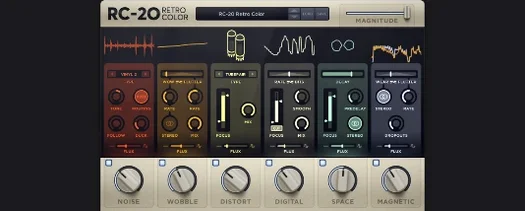
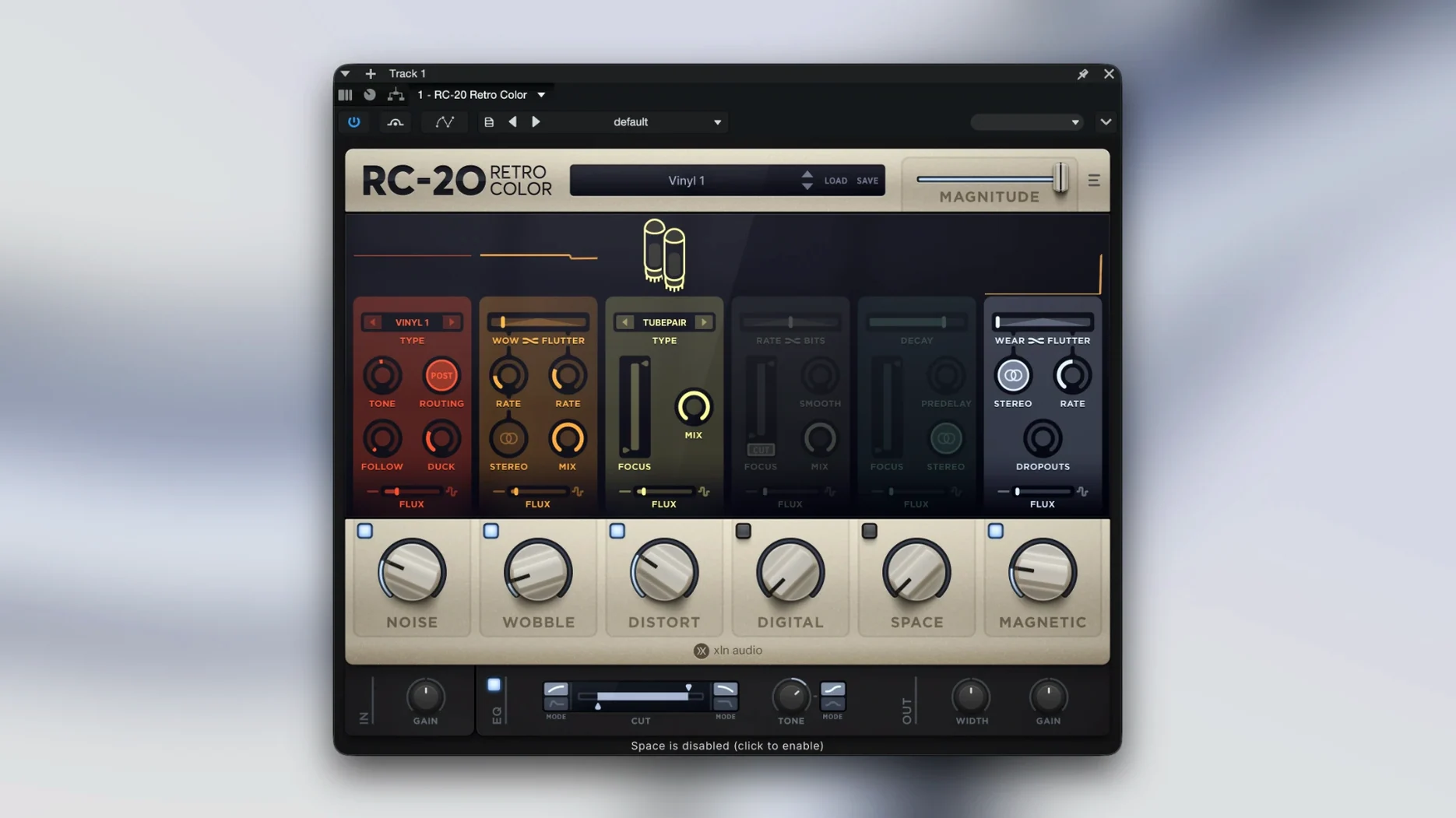
Six effect modules form the core: Noise, Wobble, Distort, Digital, Space and Magnetic. Each one models a different flavour of analogue degradation, from vinyl crackle and tape warble to bit-crushing and speaker emulation. A Flux engine lets you set how much each parameter drifts over time, so the texture never sits still. The result is a tool that adds life and grit to clean recordings — useful on drums, keys, vocals or an entire mix bus — without forcing you to hunt down a broken four-track. A built-in manual link sits right in the interface if you need a quick reference while tweaking.
Apple Silicon support removes Rosetta overhead on M1 and M2
Version 1.5.1 brought Apple Silicon support that actually matters in a session. On an M1 or M2 Mac, the plugin now loads without Rosetta overhead, which means you can stack eight or ten instances on a busy mix without the CPU meter climbing the way it used to. Earlier 1.5 builds also tightened the Flux engine's timing so the random modulation no longer drifts out of sync on looped playback — a small fix that stops a drum loop from sounding subtly different every time it cycles. Users who grab an RC-20 crack from places that still distribute 1.4.x builds should note those older versions miss both the native silicon binary and a fix for a crash that occurred when bypassing the Space module during playback in Logic Pro; running the standalone installer over the top usually updates the binary cleanly. The 1.5.1 installer also cleaned up an issue where the AU component would fail validation on Monterey clean installs. If the plugin seems unstable, the version number in the bottom-right corner of the interface tells you everything.
Set Magnitude and a second global control before touching any knob
RC-20 opens with a flat preset — everything off, all modules bypassed. That is the right starting point, but two global settings deserve attention before you touch a single knob.
First, open the Magnitude control in the top bar and pull it back from 100%. Magnitude works as a master wet/dry balance for the entire effect chain, and at full strength the processing can overwhelm a signal that already has its own character. Dropping it to 60–75% often yields a more usable blend without forcing you to pull back individual module levels. It is the single fastest way to stop RC-20 from sounding like a caricature.
Second, check the Output trim. The Distort and Magnetic modules both add gain, and many presets push the output 3–6 dB above the input level. If you audition presets with loudness normalisation off, everything sounds better simply because it is louder. Trim the output so bypassed and active levels match, then judge the processing honestly.
Option-click a module icon to solo it instantly
Most users learn the six module icons across the top and the big Flux slider within minutes. A handful of less obvious moves can speed up your workflow considerably.
Option-click any module icon to solo it. This mutes the other five modules so you can hear exactly what the Wobble or Digital section is contributing. It works during playback and saves you from toggling five bypass switches one by one. The solo state clears when you click another module or click the same icon a second time.
The Flux drop-down menu (the small arrow beside the Flux label) contains a per-parameter routing matrix. By default, Flux applies the same random modulation amount to every active parameter, but you can untick individual destinations. If the noise floor warbling adds character but the reverb decay wobbling just sounds seasick, you pull that one parameter from the Flux bus without touching anything else.
Shift-drag on any knob engages fine-adjust mode. The control moves at roughly one-tenth the normal speed, which matters on the Noise Tone knob (where a few pixels separate white noise from vinyl crackle) and on the Digital module's Bit Depth slider (where the difference between 8-bit and 6-bit is the line between lo-fi charm and unintelligible hash).
Dry signal ducking is not a dedicated feature, but you can fake it with the Magnitude control and automation. Ride Magnitude up during gaps in a vocal phrase and down when the singer is active, and RC-20 behaves like a texture pad that gets out of the way.
Mistakes that make it sound worse
The most common beginner error is treating all six modules as a checklist. A synth pad probably does not need bit-crushing, vinyl noise and tape warble simultaneously. RC-20 rewards restraint: pick two or three modules that serve the track, set them carefully, and bypass the rest. A mix where every channel wears all six effects turns into a muddy, midrange-heavy mess within eight bars.
Another misstep is ignoring gain staging between modules. The signal chain runs Noise → Wobble → Distort → Digital → Space → Magnetic, left to right. Driving the Distort module hard and then feeding it into the Space reverb produces a completely different texture than running the reverb first and distorting the tail. If the sound feels choked, check whether the Distort output is clipping the Digital module's input. Back it off a few dB and the top end often opens up.
Beginners also tend to set Flux too high across all parameters and then wonder why the stereo image wanders. Flux values above 30% on the Wobble module's Stereo Phase parameter can push hard-panned elements past the speaker boundary. Keep Flux subtle on spatial parameters and let it run wilder on things like noise level or tape age — parameters where drift sounds like character, not like a broken mix.
Some users searching for an rc 20 retro color torrent end up with an installer that predates the 1.5.1 fixes. Those older builds lack the Output trim calibration and can exhibit a known bug where the Noise module's envelope follower misreads transient-heavy material above -6 dBFS input. If the noise floor pumps oddly on a snare track, the version you are running is likely the culprit, not your settings.
Modules that work better in combination
Certain module pairs produce results that neither can achieve alone. Running the Magnetic module's Wear control at a modest setting (around 35%) into the Space module's Room algorithm creates a believable small-amp-in-a-living-room sound that works for lo-fi guitar and electric piano. The Magnetic section rolls off the high end and adds subtle saturation; the Space section places the result in a short, dark reflection pattern. Neither module sounds particularly convincing in isolation for this purpose, but the cascade does the job.
The Digital module's Rate Reduction parameter paired with a slow Flux on the Noise module's Level control yields a texture that evokes a worn sampler with a fluctuating noise floor — useful on drum breaks and one-shot vocal chops. Set the Digital Rate to 22 kHz or lower, bring the Noise Level up to about 20%, and tie both to Flux at 15–20% range. The result shifts enough to stay interesting but remains recognisable on repeat listens.
- macOS 10.13 or later
- Intel or Apple Silicon Mac
- 64-bit host
- VST, AU or AAX compatible DAW
Questions on file
What effect modules does RC-20 Retro Color include?
It has six modules: Noise, Wobble, Distort, Digital, Space and Magnetic, each recreating a different aspect of vintage recording gear.
What is the Flux engine for?
The Flux engine introduces random, continuous variation over time, making the effect feel alive instead of static.
Which plug-in formats are supplied on Mac?
The Mac version includes VST, AU and AAX formats for broad DAW compatibility.
Sign in · Create an account to add a field note.
No field notes yet. A measurement, a version, a machine — they appear after moderation.