
Video
Infuse Pro 8.5.5 CRACKFIX
VideoUpdated
| Requirement | On file |
|---|---|
| macOS | macOS 12 or later |
| CPU | Apple Silicon, Intel 64-bit |
| Download | 90 MB |
Version 8.5.5 arrived on September 16, 2026, syncing the iOS and iPadOS releases with the Mac edition. The update is a maintenance pass that keeps the playback engine current.
What makes its audio passthrough different?
Infuse Pro decodes Dolby Digital Plus (AC3/E-AC3), DTS, and DTS-HD without extra plug-ins. The app sends the raw bitstream to your receiver, so you hear the mix the studio authored, not a downmix.
How does it find files on a home server?
It connects to Mac, PC, and NAS shares over SMB, NFS, FTP, and WebDAV. You browse folder structures directly, and the library auto-indexes new files as they appear on the network.
Can I add subtitles to anything I play?
Stability Release That Aligned Mac Playback
Infuse 8.5.5 is not a feature drop. It is a stability release that brought the Mac version in line with the iOS and iPadOS builds released on the same day, 16 September 2026. The playback engine received minor corrections that affect how the app handles HDR tone mapping on displays with peak brightness above 1000 nits. If you use an XDR panel or a third-party monitor with high luminance headroom, you may notice fewer frame drops during the first three seconds of playback when switching between SDR and HDR files. The change is subtle — no new controls, no preference toggles — but the interruption that occasionally hit the opening credits of a Dolby Vision rip is now absent.
The library scanner also changed its fingerprinting logic for TV shows. Earlier versions sometimes grouped multi-file season packs under a single entry when file names used non-standard numbering. The 8.5.5 build tolerates more variations in episode numbering, which means fewer manual metadata edits if your collection was ripped from discs with unusual track layouts.
One quiet improvement affects network share browsing over SMB. Folders with more than 4,000 items now populate the list in roughly half the time they took in 8.4.x. The team at Firecore tightened the directory enumeration calls without touching the SMB protocol version, so no config changes are required on the NAS side.
Switch Audio Output from Auto to Direct
Out of the box, Infuse makes several choices that favour simplicity over precision. Reversing a few of them takes under two minutes and pays off immediately.
- Audio output mode. Navigate to Settings > Audio and switch from Auto to Passthrough. Without this change, the app decodes DTS-HD Master Audio and Dolby TrueHD to PCM before sending the signal. Passthrough preserves the original bitstream for an external receiver.
- Subtitle download behaviour. Under Settings > Subtitles, set Auto-download to Manual. Leaving it on Automatic fetches the first match from OpenSubtitles, which is often a machine-translated file for niche titles. Manual mode lets you pick from the list.
- Library sync interval. The default refreshes iCloud sync every 15 minutes. If you watch across an iPhone, iPad, and Mac in the same evening, drop it to 5 minutes under Settings > Sync. The battery cost on a plugged-in Mac is negligible.
- Volume boost for quiet tracks. Many MKV files ripped from Blu-ray have centre-channel dialogue that sits too low. Enable Settings > Audio > Volume Boost and set it to +3 dB. It lifts speech without clipping the dynamic range.
21:00 Routine from Dock to External Display
It is 21:00. The MacBook Pro is on the desk, and a 32-inch external display swings toward the sofa. Infuse Pro sits in the Dock.
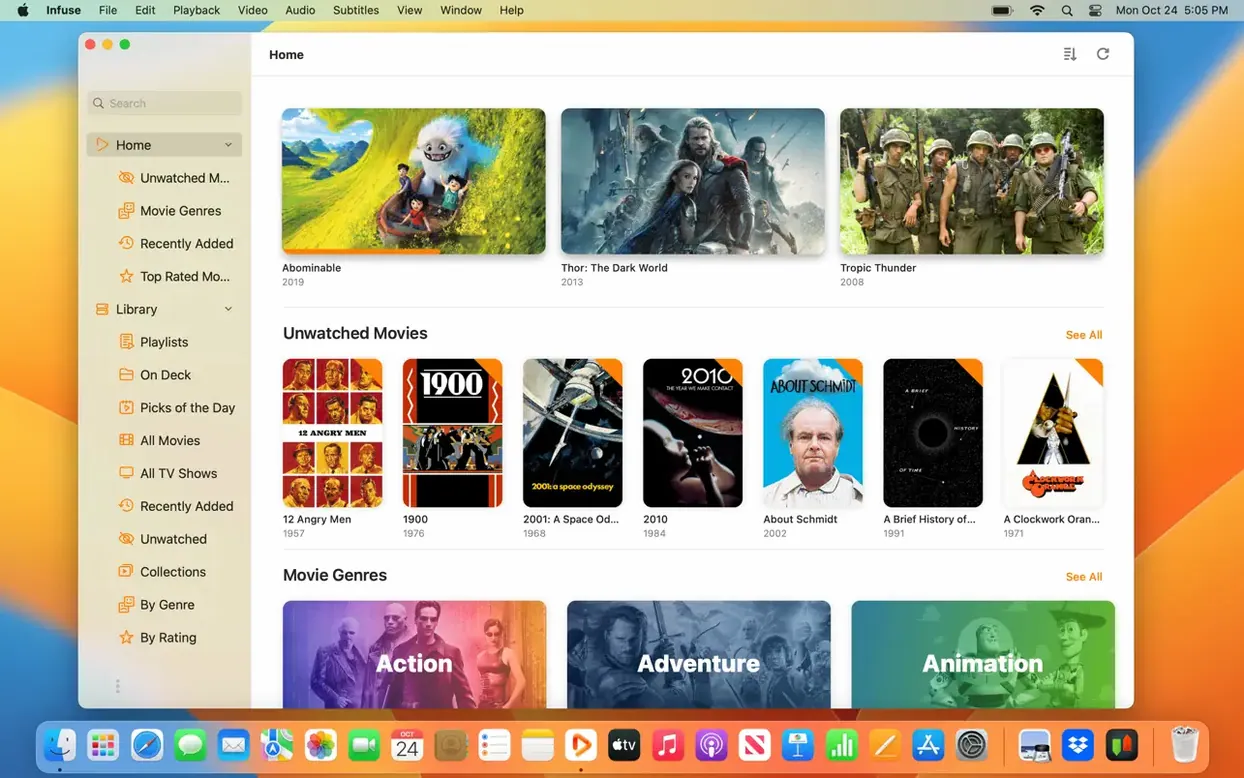
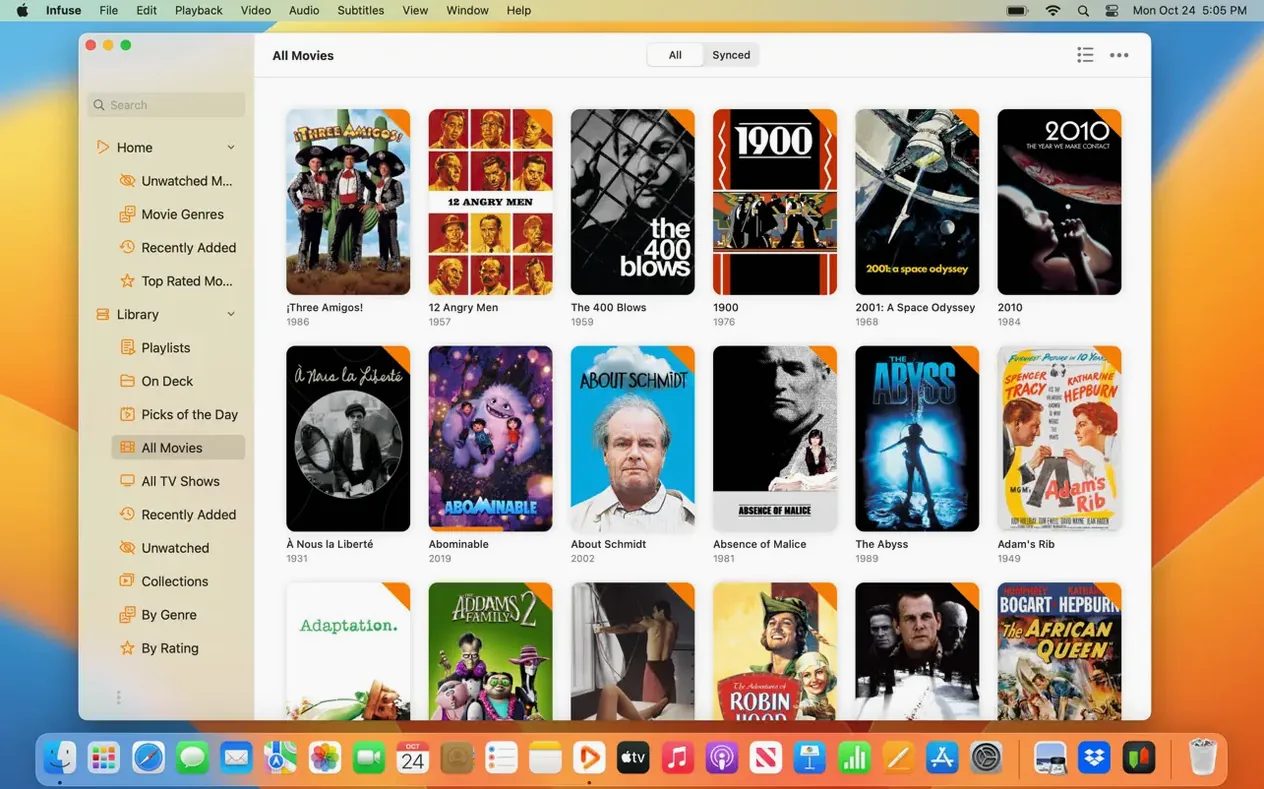
- Launch the app. The library opens on the last-used view — a grid of movie posters pulled from a Plex server on the local NAS. The Recently Added shelf shows three new files copied earlier from a Blu-ray rip of a Criterion release.
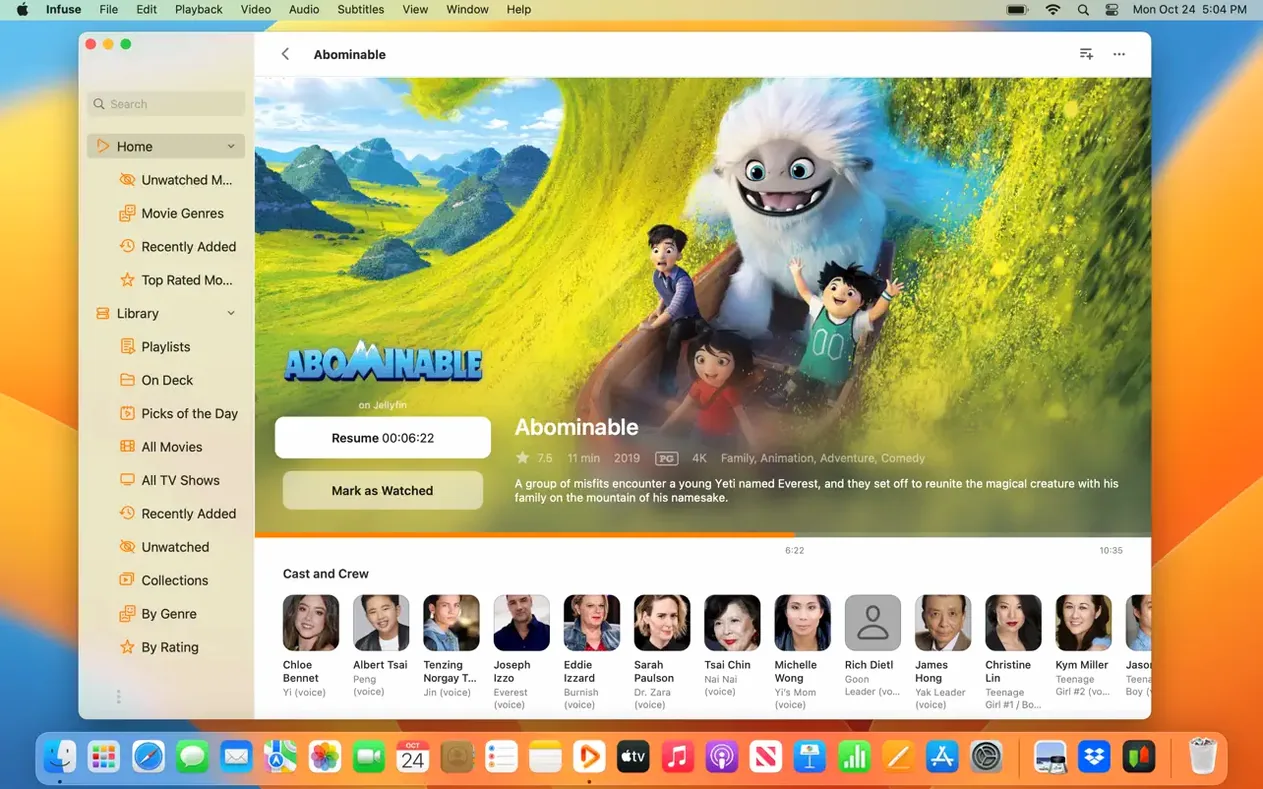
- Pick a file. The film title is in Korean with an English subtitle track flagged as PGS. Tapping the poster starts playback. Infuse recognises the file as an MKV with two audio tracks and four subtitle streams.
- Adjust subtitles on the fly. The PGS track renders with a dark grey stroke that washes out on the brighter scenes. Hitting the subtitle icon during playback opens the timing and appearance panel. The font outline is changed to black, and the vertical position is nudged 6 pixels higher to clear the letterbox bar. The change applies instantly without restarting the file.
- Swipe to skip extras. A 90-second studio logo loop opens the file. A two-finger swipe right on the trackpad jumps 30 seconds forward, bypassing it cleanly. The gesture is faster than hunting for a skip button on screen.
- Pause and resume across devices. Forty minutes in, the lid is closed. Later, an iPad on the nightstand picks up the in-progress queue from iCloud. The same playback position is waiting, with the subtitle customisations intact. That sync is what the Pro tier pays for.
- Finish the session. Back on the Mac the next evening, the film resumes from 42:18. When the credits roll, Trakt marks the file as watched and the poster moves from In Progress to Watched.
Skip Drag-and-Drop, Connect a Share Instead
New users tend to treat Infuse as a Finder replacement and run into the same half-dozen friction points. Most are easy to unwind once you know where the switches live.
- Adding files directly instead of connecting a share. Drag-and-drop works for a quick test, but it bypasses the library scanner. The file never gets metadata, never syncs watched status, and disappears from Recent after the app restarts. Connecting the NAS or Plex server once — under Settings > Add Files — builds a persistent catalogue.
- Ignoring the subtitle offset controls. When an external SRT file drifts by half a second, beginners download a different subtitle file instead of using the built-in timing offset. The slider under the subtitle menu adjusts sync in 100 ms increments while the video keeps playing. The fix takes less time than finding a new file.
- Leaving the video decoder on Auto for 4K HEVC files. Auto mode sometimes picks software decoding on Intel Macs with weaker integrated graphics, causing dropped frames. Switching to Hardware under Settings > Playback forces GPU decoding and keeps the 4K stream smooth on a 2019 iMac or later Intel hardware.
- Storing the library database on an external drive that sleeps. Infuse writes its metadata cache to
~/Library/Application Support/Infuse. Moving that location to a spinning external disk that parks its heads every 10 minutes introduces lag when browsing the library. Keep the database on the internal SSD and store only the media files externally. - Expecting the app to transcode for remote streaming. Infuse is a direct-play client. It does not transcode video on the fly. If the network pipe is too narrow for a 60 GB remux, the file will buffer. The solution is to pre-select a lower-bitrate encode or upgrade the Wi-Fi link; some users also explore an Infuse Pro crack to unlock premium codec support while relying on their own encode management.
Yes. Infuse pulls subtitles from OpenSubtitles in real time, and you can drop an external subtitle file onto the playback window without stopping the video.
- Version 8.5.5 — synchronised release across iOS, iPadOS, and Mac, matching the September 16, 2026 update cycle.
- macOS 12 (Monterey) or later
- Apple Silicon or 64-bit Intel processor
Questions on file
Which Mac hardware does Infuse Pro support?
It runs natively on Apple Silicon and 64-bit Intel Macs, requiring macOS 12 Monterey or later.
Sign in · Create an account to add a field note.
No field notes yet. A measurement, a version, a machine — they appear after moderation.