
Games
The End of the Sun 2.0.2
GamesUpdated
| Requirement | On file |
|---|---|
| macOS | See the sheet |
| CPU | Apple Silicon, Intel 64-bit |
| Download | 5.8 GB |
| Tested on | macOS Sequoia, MacBook Air (M1. 2020) |
Version 2.0.2 lands as a stability and polish update, keeping the core experience sharp for Mac players. The game runs natively on both Apple Silicon and Intel Macs, tested here on a MacBook Air (M1, 2020) under macOS Sequoia. Here is what the setup and first hours look like.
Getting started
- Mount the downloaded disk image.
- Drag the app bundle into the Applications folder shortcut.
- Launch from Launchpad once copying finishes. On first launch, grant any requested permissions for saved games.
Performance and feel
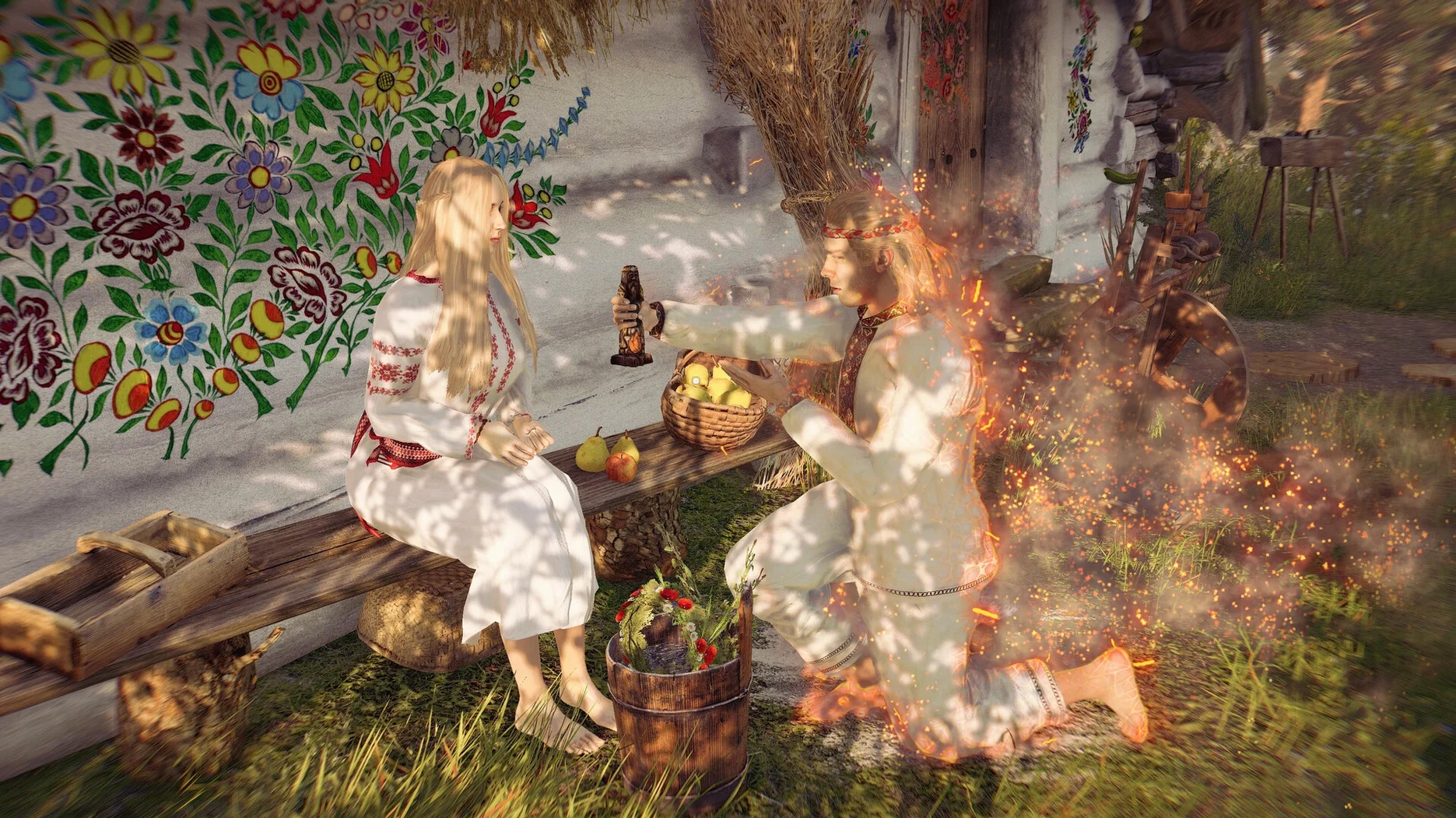
On the fanless M1 Air, the game holds 30 fps at default settings in most village and forest scenes, with minor dips during weather transitions. The photogrammetry-sourced assets — scanned from real ethnographic museum pieces — give interiors a tactile quality that benefits from even a modest Retina display. Time-of-day and weather shifts alter the entire palette of a scene, which keeps backtracking through the nonlinear story from feeling repetitive.
Controls and puzzles
The first-person controls map cleanly to a mouse and keyboard, with interaction prompts appearing contextually. The puzzles avoid conventional adventure-game logic. As the Ash Priest, you manipulate time itself to solve them, which means solutions often require observing how an object or location changes across different moments rather than combining inventory items.
Nonlinear seasons reshape one village
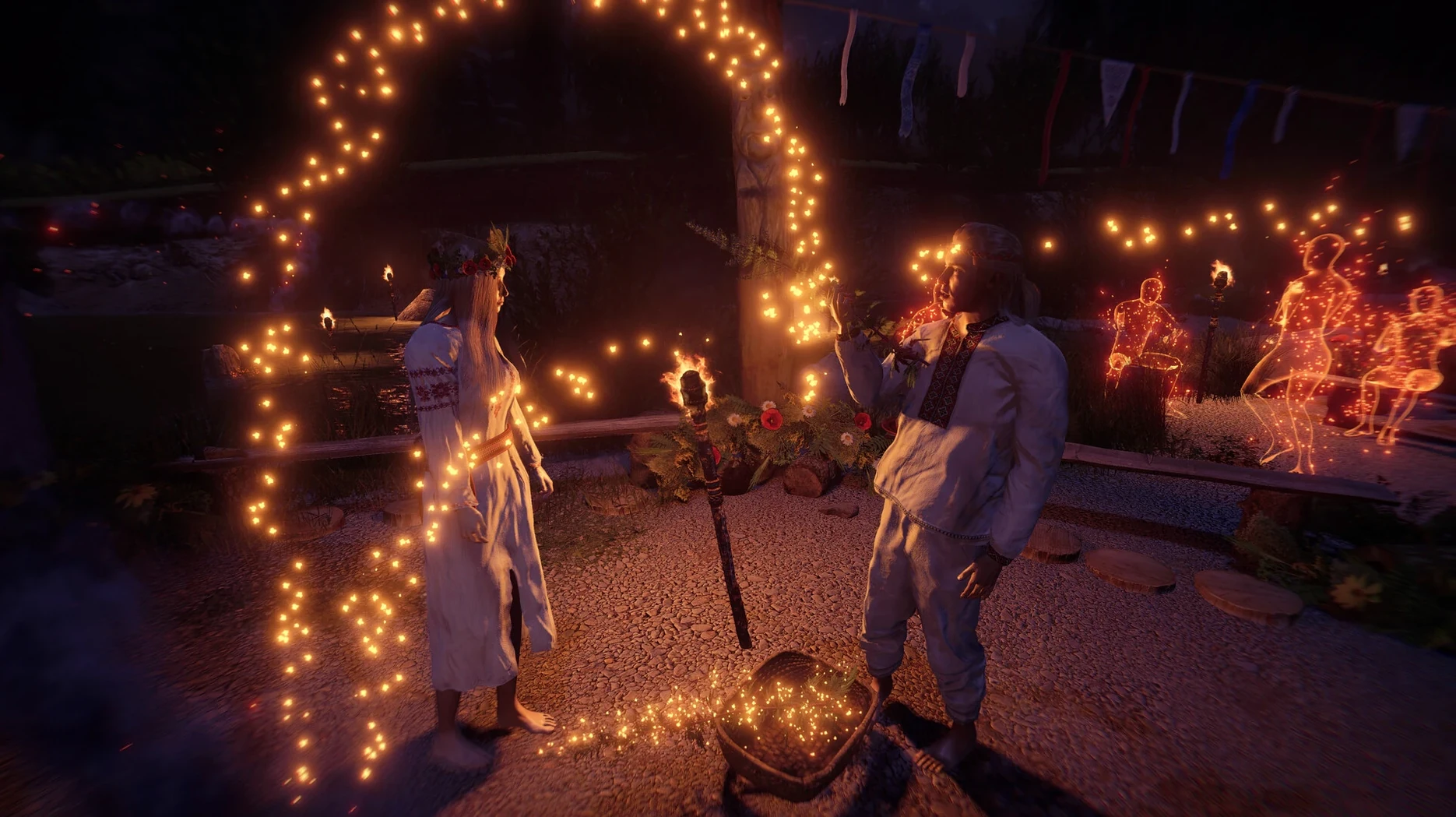
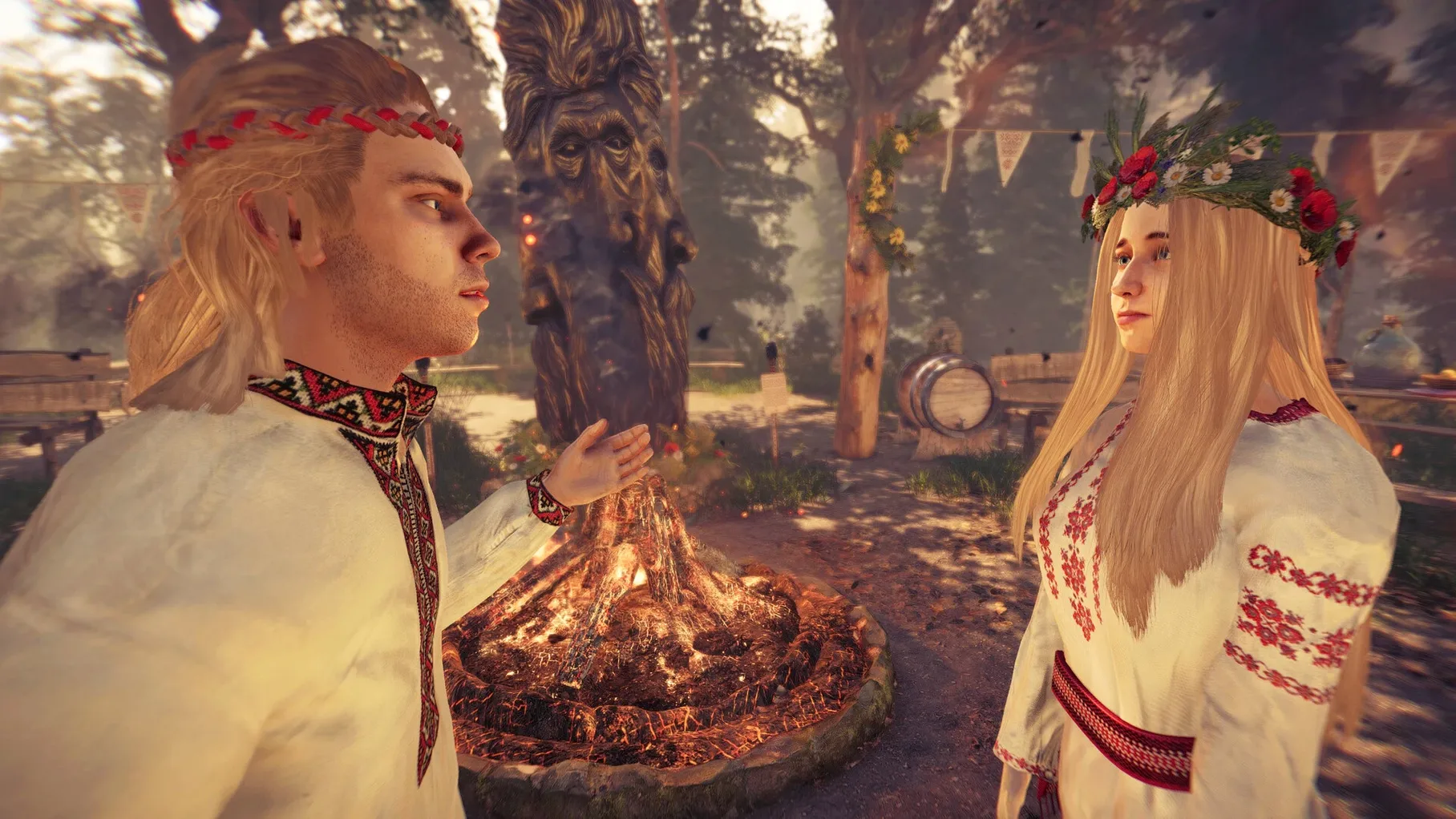
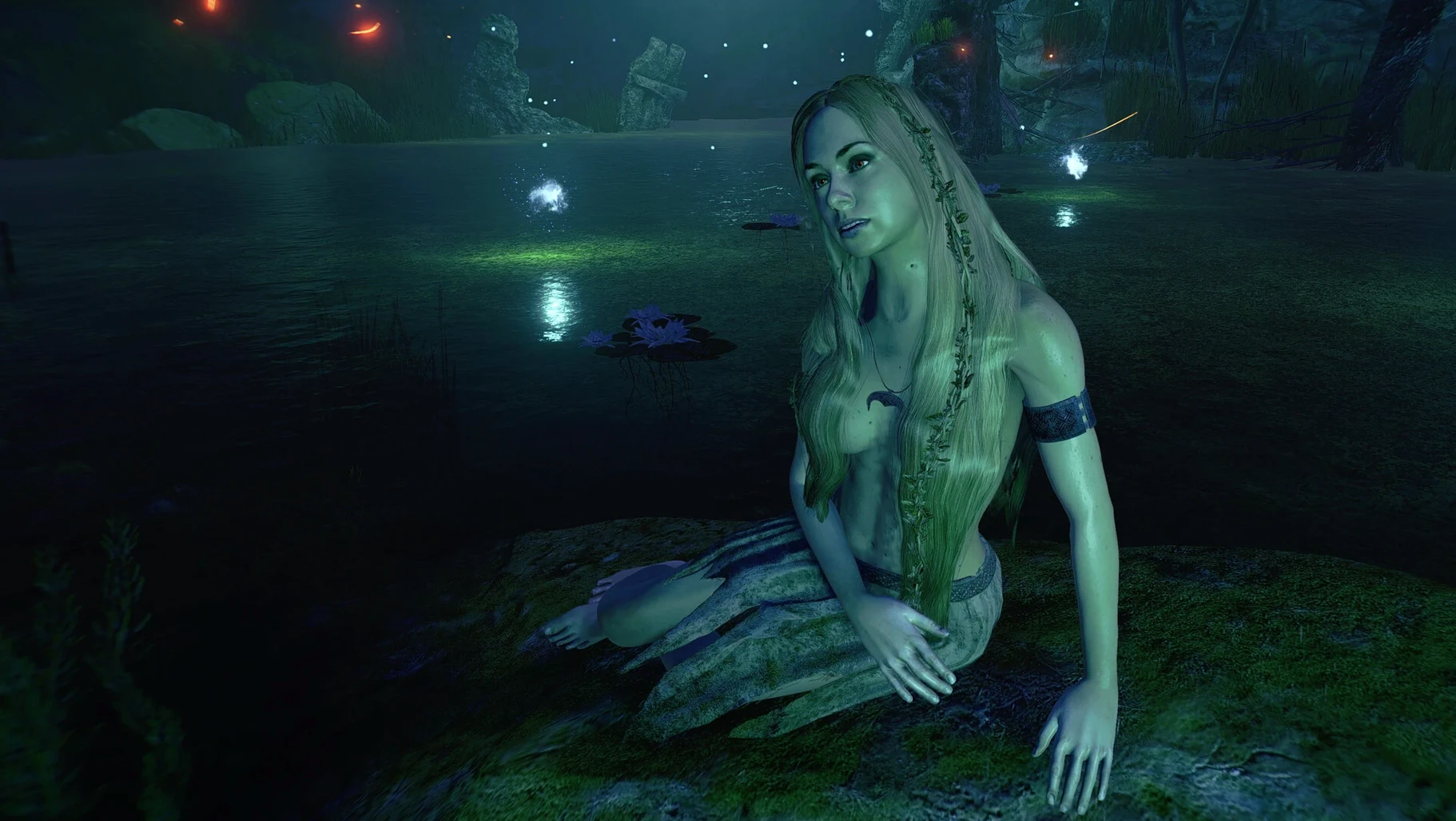
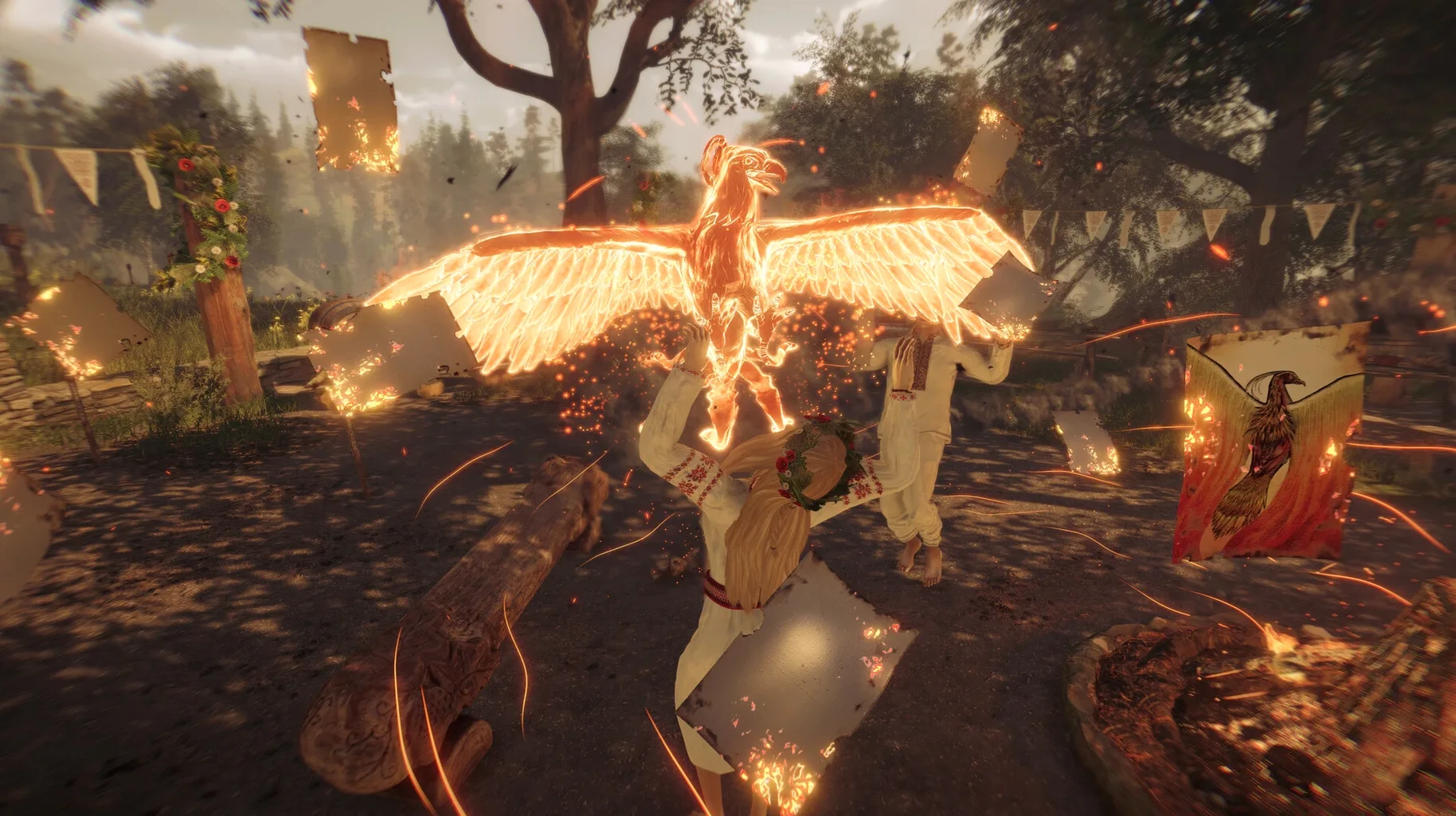
Exploration centres on a single village and its surroundings across four seasons. The nonlinear storytelling means choices about which time period to visit next are genuinely open, and the environment reacts with distinct lighting, weather, and available paths. The Slavic fantasy setting draws directly on folklore rather than generic medieval tropes, and the museum-sourced textures reinforce that sense of place.
Weather shifts lock and unlock paths silently
A few things trip people up in the first couple of hours.
Stuck after a weather shift. When the environment changes, previously open paths can close and new ones appear. The journal does not always spell out which time period to visit next. Check the central fire pit — the Ash Priest's clues are tied to fire sources, and a new flame or an extinguished one often signals where the story wants you to go.
Puzzle logic feels opaque. If an object seems to do nothing when interacted with, shift to a different season and examine the same spot. A locked chest in summer may be buried under snow in winter, and the solution is not about finding a key but about being in the right moment. The photogrammetry assets are not just decorative — small details on carvings or embroidery change across time and sometimes point to the next step.
Performance stutter during season transitions. On the M1 Air, the frame rate can dip briefly when the full environment reloads. This is normal and settles within a few seconds. If it persists, lowering shadow quality in settings resolves it without much visual loss.
Tracing every fire source from Kupala Night
Here is a concrete sequence for investigating a single mystery thread.
- Start in the village during Kupala Night (summer). Note every fire source — bonfires, hearths, candles in windows — and mark them mentally against the landscape.
- Travel to the same location in early spring. Some fires will be absent. The ones that remain in exactly the same position are the fixed points the story is built around.
- Examine each fixed fire source in at least three seasons. The Ash Priest can perceive residues — objects near these fires carry different interaction prompts depending on the time of year.
- When you find an object that reacts differently across two seasons, that is your lead. Follow it to the next fire source rather than wandering the full map.
This method cuts down aimless backtracking and keeps the nonlinear structure manageable.
A folklorist's first evening
Someone coming to the game with a background in ethnography or Slavic studies will notice the museum sourcing immediately. A carved distaff leaning against a cottage wall is not generic set dressing — it matches a 19th-century piece from the Podhale region, and the same carving motif appears later on a ritual mask worn during the winter festival sequence. Following that visual thread across seasons becomes its own investigation, separate from the main mystery. The game rewards that kind of attention: the photogrammetry is not just texture fidelity, it is a narrative device. The full version of the end of the sun mac builds its nonlinear story from these material details rather than from dialogue trees, which suits a player who would rather read an object than a journal entry.
- macOS (tested on Sequoia)
- Apple Silicon or Intel Mac
Questions on file
Does The End of the Sun run on Intel Macs?
Yes, version 2.0.2 supports both Apple Silicon and Intel Macs.
What languages does the game support?
The interface supports Russian, English, German, Spanish, Italian, Simplified Chinese, Polish, Ukrainian, French, and Czech.
Sign in · Create an account to add a field note.
No field notes yet. A measurement, a version, a machine — they appear after moderation.