VST Plugins
KORG Collection 1.0.3
VST PluginsUpdated
| Requirement | On file |
|---|---|
| macOS | macOS 10.13 or later |
| CPU | Apple Silicon, Intel 64-bit |
| Download | 175 MB |
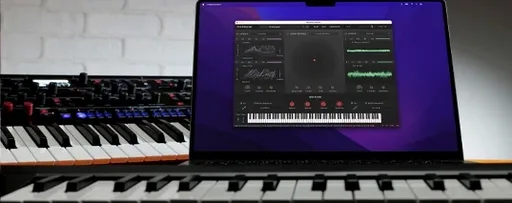
KORG Collection is a suite of software synthesizers and virtual instruments that runs inside a DAW on a Mac or PC. The 2026 update expands the toolkit considerably, adding four new instruments to the roster. Each addition targets a specific sound-design or performance task, from polyphonic synthesis to acoustic piano playback. The architecture handles both Apple Silicon and 64-bit Intel processors without a separate install path.
- TRINITY — a three-voice architecture for layered pads and evolving textures where three distinct timbres interact under one set of controls.
- PS-3300 — a semi-modular polyphonic design with three signal generators per voice, built for complex, animated patches that shift over time.
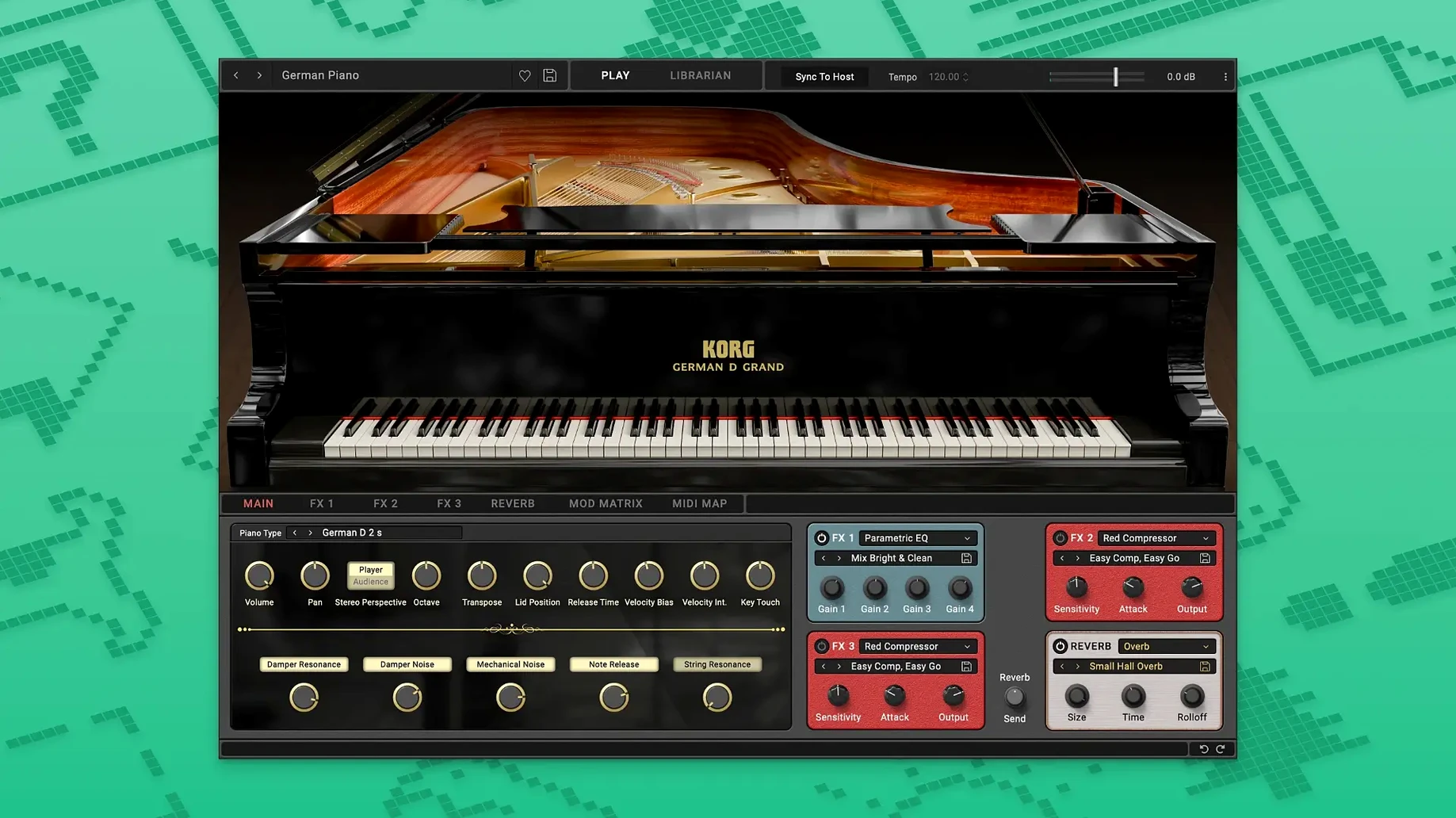
- SGX-2 — a virtual concert grand piano that delivers rich, expressive piano sound with una corda, damper resonance, and string resonance modelling.
- Filter Ark — an effect module with two multi-mode filters and a modulation matrix, useful for sculpting movement into static sources or placing synths in a physical space.
The instruments operate inside any host that loads VST or AU plug-ins on macOS 10.13 or later. The sound sits somewhere between a faithful hardware reissue and a modernised digital tool—enough character to cut through a mix, enough CPU restraint to run several instances at once.
A short piece: programming a decaying pad on the PS-3300
The PS-3300 rewards a methodical approach. Start with an empty DAU project and load one instance on a MIDI track. Set the tempo to 100 BPM for a reference pulse, then initialise the patch by pulling all three signal generator level sliders to zero and killing the modulation routings. This gives you a blank slate—the instrument ships with no global init function, so you build your own.
Raise generator 1 to roughly 70% and assign it a sawtooth waveform. Tune it to 8' pitch. Bring generator 2 in at 40% with a square wave tuned a fifth above—7 semitones up—and detune it by +3 cents. Generator 3 runs a triangle wave at 16' pitch, volume around 25%, panned slightly right. The three generators now create a thick, chorusing fundamental with a hollow midrange layer underneath.
Route a slow LFO to the master VCF cutoff. Set the LFO shape to triangle, rate to 0.4 Hz, and modulation depth to roughly 30%. The filter is a 24 dB low-pass design; keep the resonance below 40% or the self-oscillation will overwhelm the pad. Patch envelope 1 to amplifier level with an attack of 800 ms, decay of 2.4 s, sustain at 60%, and release of 1.8 s. The result is a pad that swells gently and hangs in the air for almost two seconds after you lift your fingers.
Add a touch of the internal chorus—mix at 25%, depth at noon. The stereo image widens without turning into a wash. Record a four-bar chord progression and let the last chord ring out. The natural beating between the detuned generators creates movement that needs no extra automation.
Tweak the MIDI velocity curve for a lighter touch
A few adjustments make the collection feel less like a set of defaults and more like your own instrument rack.
- Global MIDI response curve. The default velocity mapping on the SGX-2 favours a heavier touch. Open the Keyboard Response panel and pull the curve toward a softer slope—around 40% from the left—if you play on a semi-weighted controller. This brings pianissimo passages within reach without having to hammer the keys.
- Polyphony ceiling. Several synths default to 16 voices. On a modern Mac that figure is conservative. Push TRINITY and PS-3300 to 24 or 32 voices if you layer sustained chords. The CPU hit is modest on Apple Silicon; the payoff is fewer note-stealing artifacts during long decays.
- Oversampling behaviour. Filter Ark processes at 2× oversampling by default. If you insert it across a bus with several source tracks, try 4×. The high-frequency phase shift is tighter, and the filter sweeps retain more air above 10 kHz. Save the setting as part of your template so it sticks.
- Plugin window scaling. The interface defaults to 100%, which can feel cramped on a 27-inch display. Each instrument offers scaling up to 150% in 10% increments. 130% hits a sweet spot between legibility and screen real estate on a 2560×1440 monitor.
One piano instance on an M1 Max uses under 8% CPU
After two weeks of using the collection across Logic Pro and Ableton Live sessions, the performance picture is consistent. On an M1 Max machine with 32 GB of RAM, a single SGX-2 instance with full resonance modelling and reverb engaged adds roughly 3–4% to the CPU meter at a 256-sample buffer. TRINITY sits slightly lower—around 2% per instance with three active layers—while the PS-3300 can edge toward 6% when all three generators drive the filter hard. These are single-core measurements; the plug-ins do not distribute across cores in a meaningful way, so the practical limit is whatever one performance core can handle before the audio thread glitches.
Stability over eight-hour sessions has been uneventful. No crashes during patch changes, no GUI freezes when switching between instruments inside a project, and no issues with AU validation in Logic. One session pushed 14 instances across eight tracks—a mix of TRINITY pads, PS-3300 bass, and three Filter Ark inserts—and playback remained solid at 128 samples. The memory footprint for that setup hovered around 1.8 GB, which leaves plenty of headroom for sample libraries on the same machine.
The instruments load quickly. Cold-launching a TRINITY instance takes under a second; the SGX-2 piano loads its sample set in roughly 2.5 seconds on an internal SSD. There is no background indexing or authorisation polling that drags on after the plug-in appears. This matters when you are auditioning sounds and flicking between presets rapidly—the collection keeps pace.
One quirk worth noting: the Filter Ark GUI redraws slightly slower than the others when you drag the filter nodes. On an Intel Mac the lag is perceptible at roughly 100 ms behind the mouse cursor; on Apple Silicon it is barely noticeable. Not a dealbreaker, but something you will spot if you ride cutoff sweeps by hand.
Rescan one DAW at a time to avoid plug-in clashes
A few practical moves will save you time once the package is unpacked and your DAW has scanned the plug-ins.
Rescan one host at a time. If you use multiple DAWs, launch them sequentially rather than in parallel. The initial AU and VST validation writes cache data that can collide if two hosts scan simultaneously. Logic first, then Ableton, then anything else.
Build a quick-access folder. The factory preset browsers are functional but hierarchical. Spend twenty minutes tagging your ten favourite pads, basses, and keys across the suite, then save them into a DAW-side folder or bookmark system. On day three you will reach for a specific TRINITY string wash or a muted SGX-2 felt tone and the browser will feel like an obstacle. A shortlist sidesteps it.
Test the sustain pedal behaviour early. The SGX-2 supports half-pedalling and repedalling, but the response curve depends on your pedal's polarity and physical travel. Play a slow chord progression with the pedal held, then release it gradually while watching the damper resonance meter. Adjust the pedal calibration slider in the piano's settings panel until the meter tracks your foot movement linearly. Doing this on day one avoids the frustration of muddy low-end build-up in a busy mix later.
Save a template with Filter Ark on a return track. The dual-filter module works best as a send effect when you want to process multiple sources through the same moving bandpass or notch sweep. Drop it on a return, set filter A to bandpass with moderate resonance, assign an LFO to the cutoff, and leave it bypassed. You now have a go-to motion effect that you can dial in with a send knob on any track without rebuilding the routing each time. The collection rewards this kind of setup work; the instruments are deep enough that a little preparation pays off across many sessions. Users who grab a Korg Collection torrent or a Korg Collection 6 torrent to test the waters will find that the installation and activation instructions included with the package are straightforward enough to get everything running within a few minutes, after which the template-building begins. Whether you grabbed the full Korg Collection Mac torrent or a focused Korg Collection 6 Mac torrent, the first hour spent on these adjustments shapes how naturally the tools fit into your workflow.
- macOS 10.13 or later
- Apple Silicon or 64-bit Intel processor
Questions on file
What is included in the 2026 update of KORG Collection?
The 2026 update adds four instruments: TRINITY, PS-3300, SGX-2 grand piano, and the Filter Ark effect module.
Sign in · Create an account to add a field note.
No field notes yet. A measurement, a version, a machine — they appear after moderation.