VST Plugins
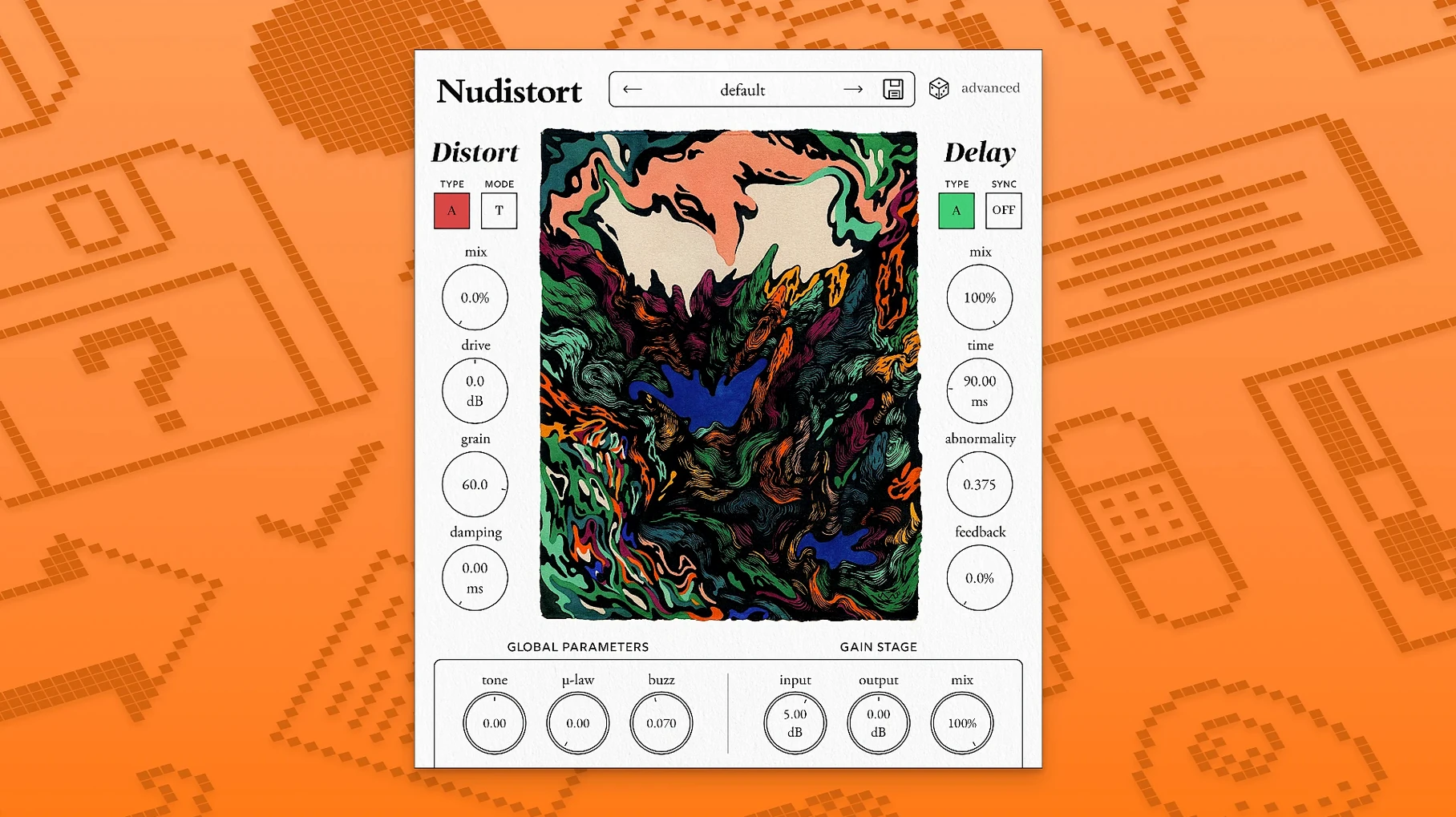
Nudist Audio Nudistort 1.2.5
VST PluginsUpdated
| Requirement | On file |
|---|---|
| macOS | macOS 10.13 or later |
| CPU | Apple Silicon, Intel 64-bit |
| Download | 45 MB |
If you've pushed standard waveshapers and clippers as far as they'll go and the result still sounds polite, Nudistort picks up where they stop. It doesn't round off edges or add gentle warmth — it rearranges the signal into something denser and more combative, with harmonic content that feels structural rather than applied on top.
Native Apple Silicon support and DAW format requirements
The plug-in runs on macOS 10.13 and later, with native support for both Apple Silicon and Intel 64-bit systems. It loads in any DAW that hosts the format, and the interface ships in English. No secondary runtime or bridge is required on Apple Silicon machines — the binary is native.
Sound and signal behaviour
Nudistort is built for noisy textures and radical shifts in audio character. The output is a dense, aggressive signal where the harmonics don't sit alongside the source — they replace much of what was there. Expect gated, splintered tones that suit sound design, industrial percussion and any scenario where you need the timbre to break rather than bend.
Drum bus test run at full wet to hear the algorithm
A drum bus is a good place to learn what the algorithm actually does. Load Nudistort onto a kick and snare group, pull the wet/dry mix to full wet so you hear only the processed signal, and tap in a simple four-bar loop. At low depth settings the attack stays recognisable — sharp transients push through, but the sustain and tail are already thinning into something granular and metallic. Crank depth past 60% and the original sample source becomes largely irrelevant; you're left with a pulsing, gated texture that follows the rhythm envelope but discards the original tone. That's the point where you start automating parameters per section, riding depth up for a bridge or breakdown so the sound fractures on cue.
For sound design work, the workflow shifts. Drop a long reverb tail or a held synth chord onto an audio track, place Nudistort in the insert chain, and set the dry/wet to around 50%. The algorithm grabs sustained harmonic material and tears it apart asymmetrically — some frequency bands distort into square-wave fizz while others collapse into silence. Record the output to a new track, chop the best two-second chunks, and you have a palette of noisy one-shots that no layered sample pack will give you. Repeat with different source material and depth settings, and label the recordings by depth percentage so you can recall what produced a particular texture.
The third common session pattern is parallel processing. Duplicate a vocal or bass track, insert Nudistort on the duplicate with depth low (15–25%) and mix at 30–40% wet, then blend the duplicate fader up underneath the clean track. The clean track carries pitch and intelligibility; the processed duplicate adds a layer of grit that moves with the performance. High-pass the duplicate around 300 Hz so the low end stays tight on the original, and automate the duplicate's mute for sections where the arrangement needs to breathe.
Three controls that move you from silence to destruction
The plug-in opens with depth at zero and wet/dry at 100%, which means no processing is audible until you move a control. That's a deliberate starting point, not a preset. The three parameters that shape results most are depth, the wet/dry balance, and the input gain feeding the algorithm.
Input gain is not a trim control — it changes how the distortion engine reacts. Driving the input hotter by 6–12 dB pushes the algorithm into a different region where the harmonic content becomes denser and the gating effect more pronounced. If a source sounds thin even at high depth, check whether the input level is too low. Conversely, backing off the input by a few dB with depth set high yields a sparser, more rhythmic breakup that works well on percussive loops.
Depth is the core control. Values between 8–20% produce a crisp, lightly fractured edge on transients; 30–50% is where the signal starts losing its original character and the harmonics take over; above 70% the output becomes a stream of crackle, noise and tonal fragments that follow the amplitude envelope of the source. There is no sweet spot that suits every source — the range behaves differently on sustained pads versus short drum hits, so treat depth as a per-track setting rather than a global preset.
The wet/dry balance matters more than it might seem. At 100% wet the output can be exhausting in a mix, but pulling back to 40–60% lets the original signal anchor the sound while the distorted layer adds bite. For bass sounds, try 30% wet with depth around 25% — the fundamental stays intact and the upper harmonics add aggression without muddying the low end.
Sound designers stripping source fingerprints for horror projects
Three groups benefit more than the rest. First, sound designers working on science-fiction or horror projects where conventional distortion leaves sounds too recognisable. Nudistort strips away the source fingerprint quickly, so a field recording of a door slam becomes a percussive burst of noise that sits in a mix like a designed element rather than a processed real-world sound. The gating behaviour at high depth is hard to replicate with a chain of standard saturation and dynamics plug-ins.
Second, electronic music producers who build drops, transitions and breakdowns with automated processing. Because the algorithm reacts to amplitude, automating depth across an eight-bar build creates a rising intensity that feels tied to the performance rather than layered on top. A search for nudistort torrent often starts with someone who heard that kind of automated breakup in a track and wants to try the same technique without committing to a purchase first — the demo covers ten days, which is enough to run it through a few project files and see if the workflow fits.
Third, users who already work with modular or semi-modular chains and are comfortable with unpredictable results. Nudistort doesn't offer precise control over which harmonics it generates or how the gating behaves at a micro level. Someone who enjoys patching a wavefolder into a low-pass gate will find the same kind of serendipity here; someone who wants a predictable saturation curve with a calibrated THD readout will be frustrated. The Nudistort crack search traffic overlaps heavily with experimental music forums where users share chains and settings, which makes sense — the plug-in rewards the kind of user who documents what works and iterates.
It's less useful for mix engineers who need transparent harmonic enhancement or mastering-grade clipping. The algorithm is too destructive for those tasks, and the lack of oversampling or band-split options means it won't slot into a clean mastering chain.
Why full mixes collapse on the master bus
Running a full mix through it on the master bus is the most common error. Nudistort wasn't built for subtle bus processing — it tears apart stereo information and collapses transients in ways that make a full arrangement sound broken rather than aggressive. If you want mix-wide texture, set up a parallel aux send, filter it heavily before and after the plug-in, and blend it in at a low level.
Another mistake is ignoring the input signal's crest factor. A heavily compressed synth pad will hit the algorithm differently from a dynamic vocal take, and the results can be surprisingly flat if the source has no amplitude variation. The algorithm feeds on dynamics — a snare hit with a sharp transient and a long decay gives it more to work with than a normalised, limited stem. Try inserting Nudistort before a compressor in the chain, not after, so the distortion engine sees the raw dynamics first.
Setting depth too high on low-frequency material without checking on full-range monitors is a practical pitfall. The harmonic content generated below 100 Hz can create sub-bass rumble that small monitors won't reveal. A high-pass filter after the plug-in, set around 40–60 Hz, cleans this up without noticeably changing the perceived aggression in the mids and highs.
Finally, some new users treat the plug-in as a preset-driven effect and scroll through factory settings expecting instant results. Nudistort ships without a large preset library — the controls are few and their interactions change dramatically with source material. The nudistort free download searches often come from users who installed the demo, opened it once, heard something harsh, and assumed the plug-in was broken. Spending fifteen minutes feeding it different sources while adjusting depth and wet/dry usually changes that impression. The algorithm isn't broken; it's just not a one-knob saturator that makes everything sound pleasantly warm.
- macOS 10.13 or later
- Apple Silicon or Intel 64-bit processor
Questions on file
What macOS versions does Nudistort support?
It is compatible with macOS 10.13 and later, including native Apple Silicon and Intel 64-bit systems.
What kind of distortion does Nudistort produce?
It creates a dense, aggressive signal with strong harmonic content, suited for noisy textures and radical audio-character changes.
Which DAWs can load Nudistort?
It works in all DAWs on supported macOS versions that host the plug-in format.
Sign in · Create an account to add a field note.
No field notes yet. A measurement, a version, a machine — they appear after moderation.